
Experiences in West Bengal queries, eventually leads to find the same answer: do you go north to the ridge or south to the delta? This one argues you plan for both or you're only reading half the state. This one is for the explorers who want more than a just sightseeing circuit.
At its northern edge, Sandakphu rises to 3,636m on the Nepal border, the only place in India from which four of the world’s five highest peaks are simultaneously visible at dawn.
At its southern edge, Royal Bengal Tigers swim between mangrove islands in the Sundarbans, the world’s largest tidal mangrove forest.
That vertical distance, from Himalayan ridge to tidal delta, covers approximately 600km within a single Indian state.
No other state manages it. It is built on cultural gravity, the accumulated pull of Bengal’s intellectual tradition, its food culture, its wilderness, and its capacity to produce experiences rare to find all within the same border.
The Terrain that Makes Experiences in West Bengal Impossible to Summarise
Four distinct terrain belts organise the geography from north to south:
The Darjeeling and Kalimpong Hills (600–3,636m) – the Himalayan and sub-Himalayan zone; tea estates, rhododendron forest, the Singalila Ridge, and the DHR toy train.
The Terai and Dooars (60–300m) – the flat river plain at the base of the Himalayas; tall elephant grass, sal forest, the river camp belt, and the major national parks (Jaldapara, Gorumara, Buxa).
The Gangetic Corridor and Heartland – the vast alluvial plain drained by the Hooghly and its tributaries; Kolkata, Murshidabad, Bishnupur, Santiniketan.
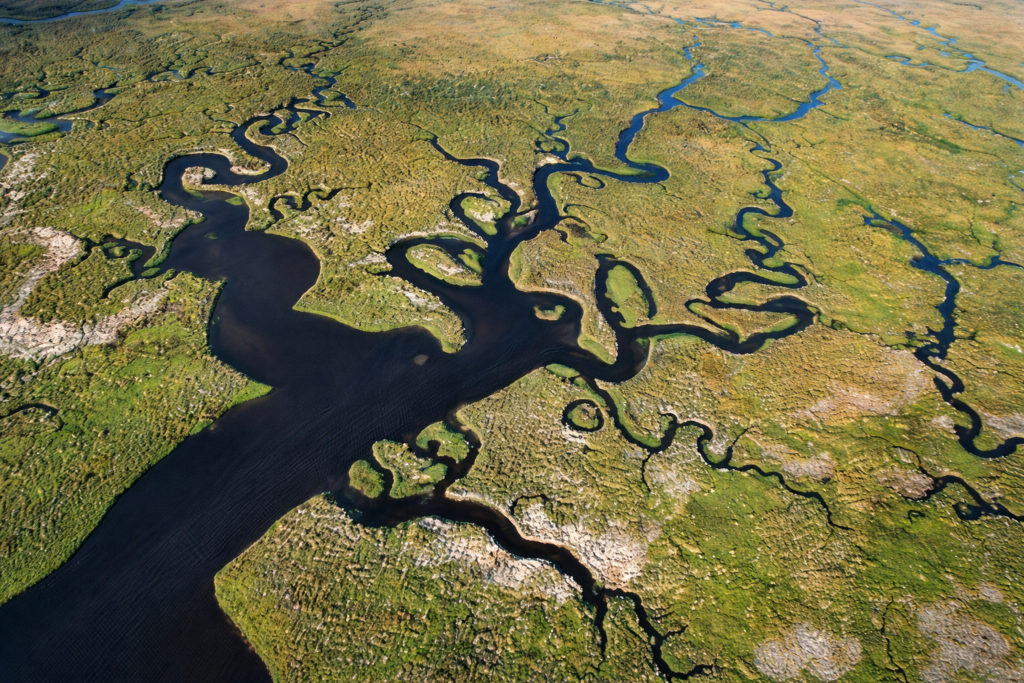
And the Sundarbans and Coastal Belt – the world’s largest active tidal delta; 102 islands, 54 of them inhabited; mangrove forest; tidal channels governed by the Bay of Bengal’s twice-daily tides.
Five rivers define movement and culture through the state:
The Hooghly (westernmost Ganga distributary; colonial trade highway for three centuries; Kolkata’s river).
The Teesta (the hill river; primary rafting water; carved the deepest gorge in northern Bengal) are the most significant.
The Torsa and Jaldhaka drain the Bhutanese Himalayas through the Dooars, creating the river camp geography.
The Damodar crosses the industrial west.
The Siliguri Corridor – approximately 20-22km wide at its narrowest, is India’s only land connection to its seven northeastern states, one of the most geopolitically significant geographic chokepoints in South Asia. All north Bengal travel passes through it.
West Bengal at a Glance
| Districts | 23 |
| Area | 88,752 sq km |
| Capital | Kolkata |
| UNESCO World Heritage | 3 – Sundarbans (1987), Darjeeling Himalayan Railway (1999), Santiniketan (2023) |
| UNESCO ICH | 3 – Baul music (2008), Chhau dance (2010), Durga Puja (2021); only Indian state with 3 ICH inscriptions |
| Foreign arrivals 2024 | 3.12 million, India’s 2nd highest after Maharashtra |
| Known for | Sandakphu trekking, Darjeeling tea, Sundarbans tiger safari, Durga Puja, Baul music, Kolkata cultural life |
What To Experience In West Bengal – More About Depth than Sightseeing
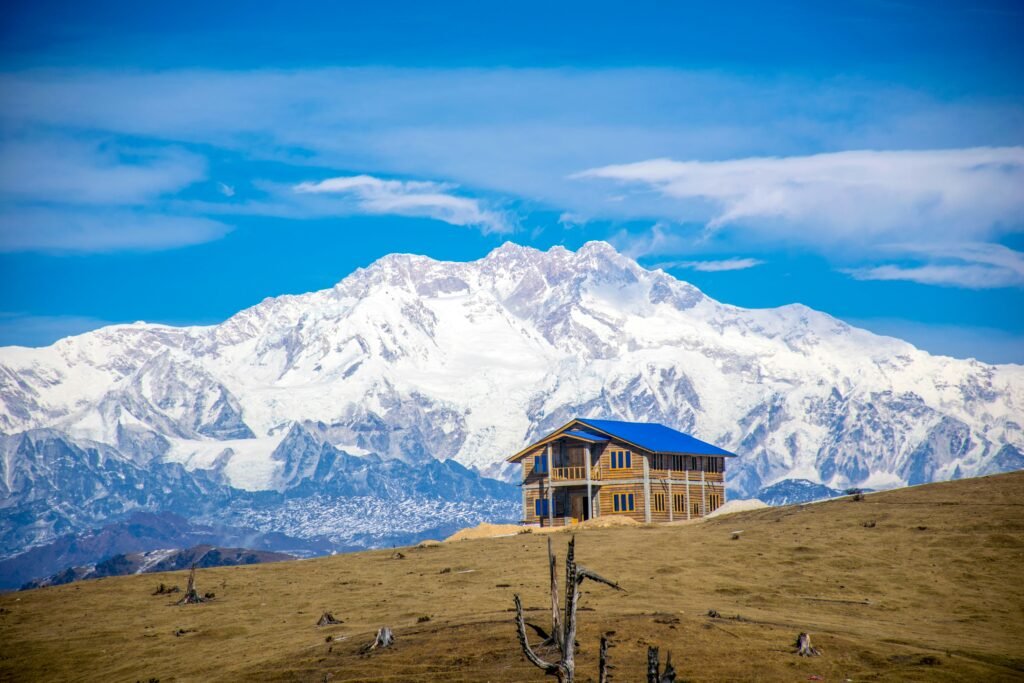
Sandakphu (Darjeeling district; 3,636m; Singalila Ridge; Nepal border) is the highest point in West Bengal and the only place in India from which four of the world’s five highest peak, Everest, Kangchenjunga, Lhotse, and Makalu, are simultaneously visible.
The ridge-line is accessible by a well-established GTA-managed trekking route and by a dedicated 4×4 jeep track; one of India’s few genuine high-altitude off-road circuits.
Above 3,000m the trail runs through rhododendron forest that turns red and white in March-April; in October and November the views reach unobstructed across four countries.
Experiences: high-altitude trekking, 4×4 off-roading, rhododendron panaroma, birdwatching, Red Panda, camping and exceptional place for astrophotography.
Darjeeling (Darjeeling district; 2,042m; Darjeeling Himalayan Railway UNESCO WH 1999) is the GDT destination not for the town itself but for the three things that cannot be replicated anywhere else;
The Darjeeling Himalayan Railway – the most atmospherically dramatic train journey in India, the dominant smell of fresh tea leaves at first-flush (March-April) when the most valued Darjeeling tea is plucked, and the dawn view from Tiger Hill of Kangchenjunga turning gold before the sun appears.
Sundarbans (South 24 Parganas; sea level; tidal mangrove delta; UNESCO WH 1987) is India’s only tiger habitat where the tigers swim – moving between 102 islands through tidal channels, hunting spotted deer and wild boar in a forest that floods twice daily with the Bay of Bengal’s tides.
The 2022 census recorded 101 tigers in the Indian Sundarbans. The experience is entirely water-based: there are no roads inside the forest, no walking trails, no jeep tracks.
Everything moves by boat through channels that the tidal schedule governs – not the clock. Beyond tigers, the Sundarbans holds Irrawaddy Dolphin, Estuarine Crocodile, Olive Ridley Turtle nesting sites, and one of India’s richest mangrove bird communities.
Santiniketan (Birbhum district; ~60m; UNESCO WH 2023) is the ashram and university town that Rabindranath Tagore built in the Bengal countryside at the turn of the 20th century.
An experiment in learning under the open sky, conducted through art, music, dance, and seasonal festivals; the tradition of learning without walls.
But Santiniketan is not primarily a heritage site, it is a living university (Visva-Bharati; founded 1921) where the Baul music tradition runs through the campus, where the Poush Mela (December), three-day fair of Baul performance, craft, and seasonal food draws musicians from across Bengal, and where the Basanta Utsav (festival during Holi; open public celebration of colour and song) is the most joyful festival in the Bengali calendar outside Durga Puja.
The places are just some amongst many, we at GDT Field Notes shall keep adding more with time.
Adventure West Bengal – Experiences Platter You Probably Didn’t Know
Trekking
The Singalila Ridge is the backbone of Bengal trekking, running from Manebhanjyang (2,134m) to Phalut (3,594m) along the Nepal border with Kangchenjunga visible for the entire upper section.
The Sandakphu route is the headline; the Phalut extension – reveals Cho Oyu, making Phalut the only point in the world with 5 of the 6 highest peaks visible.
The GTA (Gorkhaland Territorial Administration) manages all huts on the route; however, foreign nationals are restricted to GTA huts and India-side properties along this route.
4×4 Off-Roading
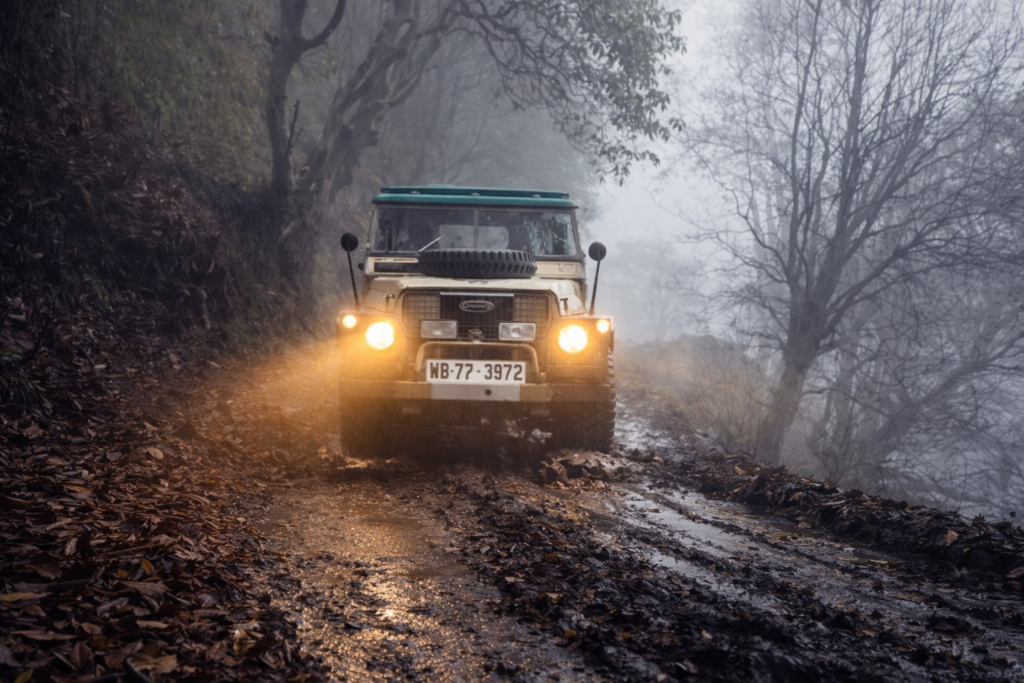
The Sandakphu jeep track (Manebhanjyang to Sandakphu summit; 30km one-way; negotiating the same ridge as the trek but by vehicle) is one of India’s only high-altitude 4×4 routes with continuous Himalayan panorama.
Self-drive (4×4 only) isn’t for the faint-hearted, a Bolero and Thar jeep hire is available from Manebhanjyang . The track requires experienced drivers; conditions deteriorate rapidly after monsoon.
White-water Rafting
The Teesta River between Rangpo and Teesta Bazaar runs Grade III–IV rapids through a deep Himalayan gorge. Season: October–December.
Commercial operators based in Kalimpong and Darjeeling run half-day and full-day programmes.
The lower Teesta (Teesta Bazaar to Coronation Bridge) is Grade II–III and suitable for first-time participants.
Paragliding
Darjeeling valley has established tandem paragliding operations (seasonal; October–May). The thermals above the tea estates are consistent in the October–November and March–April windows.
Kayaking
Buffer zone kayaking through Sundarbans mangrove channels – single-day to multi-day; run by specialist operators and several community-based tour operators in Gosaba and Sajnekhali is one of the most unusual water-based experiences in India.
The paddling is through channels that range from wide estuaries to narrow forest creeks; the wildlife proximity with Estuarine Crocodile, Irrawaddy Dolphin, and the occasional pugmark on a mudbank is best appreciated at paddle-speed.
Overland Self-Drive & Motorbike Touring
The Himalayan foothills circuit, Siliguri → Kalimpong → Lava → Rishop → Pedong → Loleygaon → Delo → back, is a 3–4 day loop through orchard country and viewpoint ridges at 1,500–2,100m that rewards overlanders and bikers specifically.
The roads are single-lane and well-surfaced; traffic is manageable outside monsoon.
The Nature and Wildlife Experiences Like Nowhere Else Does
Royal Bengal Tiger – Sundarbans
The Sundarbans mangrove tiger (Panthera tigris tigris) is a biologically distinct population adapted to swimming between tidal islands, tolerating salt water, and hunting in a habitat that floods twice daily.
The 101 tigers represent the largest single-reserve tiger population in West Bengal.
Boat-based safari through the forest reserve, moving silently through channels at dawn is fundamentally different from the jeep safari experience of Ranthambore or Corbett.
Sundarbans experience is the forest itself as much as the animal.
Indian One-Horned Rhinoceros – Jaldapara and Gorumara
The Dooars hosts the second-largest Indian One-Horned Rhinoceros population in the country after Kaziranga.
Jaldapara National Park (216 sq km; Alipurduar district) and Gorumara National Park (79 sq km; Jalpaiguri district) together hold a significant rhino population with elephant-back and jeep safari access.
The Dooars in general is the river camp belt straddling the Torsa, Jaldhaka, and Murti rivers, is among the most photogenic wildlife landscapes in the Eastern Himalayas, particularly in the October–January.
Red Panda – Singalila National Park
The elusive Red Panda (Ailurus fulgens; Vulnerable) is present in Singalila National Park at elevations above 2,500m.
Sightings are possible but not reliable without specialist guide knowledge of current territories; the best window is April–May and October–November when the animals are most active.
The trekking routes through Singalila pass through Red Panda habitat, which makes the trek simultaneously an opportunity for a genuine wildlife encounter.
Birding
West Bengal’s three distinct ecosystems – Himalayan forest, Terai/Dooars grassland, and Sundarbans mangrove, support 650+ bird species.
Key sites: Latpanchar (near Darjeeling; Pied Falconet, Himalayan birds; the most accessible specialist birding base in the hills), Jaldapara and Gorumara (Bengal Florican, Rufous-necked Hornbill), Buxa Tiger Reserve (birding corridor;
Northeast species overflow), and the Sundarbans (Masked Finfoot, Mangrove Whistler, Collared Kingfisher mangrove specialists).
Winter (November–February) brings migratory species down from the Himalayas into the Terai grasslands.
| Zone | Signature wildlife | Best season |
|---|---|---|
| Sundarbans | Royal Bengal Tiger, Estuarine Crocodile, Irrawaddy Dolphin, Masked Finfoot | Nov–Mar |
| Jaldapara / Gorumara (Dooars) | Indian One-Horned Rhinoceros, Elephant, Gaur, Bengal Florican | Nov–Apr |
| Singalila NP (hills) | Red Panda, Blood Pheasant, Satyr Tragopan | Apr–May; Oct–Nov |
| Latpanchar (hills) | Pied Falconet, Himalayan specialist birds | Nov–Apr |
Finding Wellness Experiences In West Bengal
Tea Estate Immersion
The window from mid-March to late April when the first-flush Darjeeling tea is plucked is the most specific slow-travel experience Bengal offers.
Walking the plucking rows in the early morning mist, visiting the withering and rolling facility in the afternoon, and sipping a fresh cuppa of the same morning’s leaf gazing the mountains is not just a tour but a revelation.
Several Darjeeling estates living in colonial bunglows offer structured immersive programmes.
Spiritual Retreat
Belur Math on the Hooghly River (12km from central Kolkata; headquarters of the Ramakrishna Mission; founded by Swami Vivekananda in 1899) is the most accessible serious spiritual retreat environment in the state.
The Math’s grounds combine temple, museum, and residential monastic complex in a setting that the Hooghly River amplifies into genuine stillness.
Adjacent to it lies Dakshineswar Kali Temple, the most venerated temple in Bengal, where Ramakrishna spent his formative years; Nabadwip (the birthplace of Chaitanya Mahaprabhu; Vaishnava pilgrimage centre; Navadwip Parikrama in March).
Nature Wellness
The river camp belt in the Dooars, permanent tented camps on the banks of the Torsa, Jaldhaka, Murti, and Neora rivers at the base of the Bhutanese Himalayas offers one of the most complete nature-wellness encounters in Bengal.
The camps are small (6–20 tents), positioned in riverbed forest, with elephant corridors active at night and birdsong at 5am. The absence of mobile connectivity is itself part of the offering.
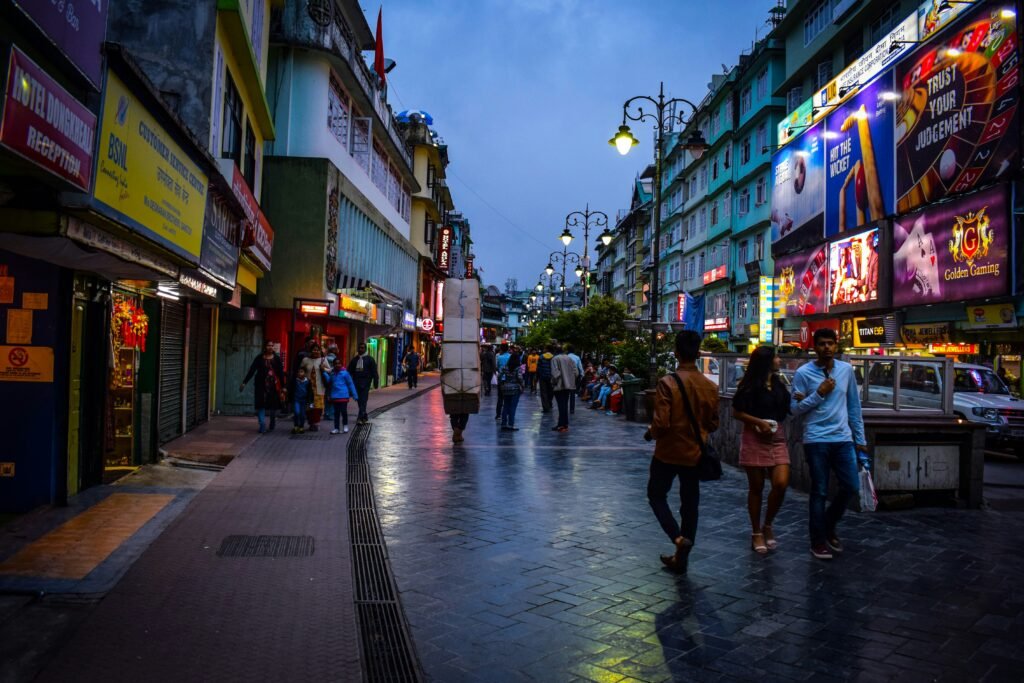
Cultural Experiences that Survived Partition, Urbanisation, and the Algorithm
Durga Puja the World’s Largest Public Art Event
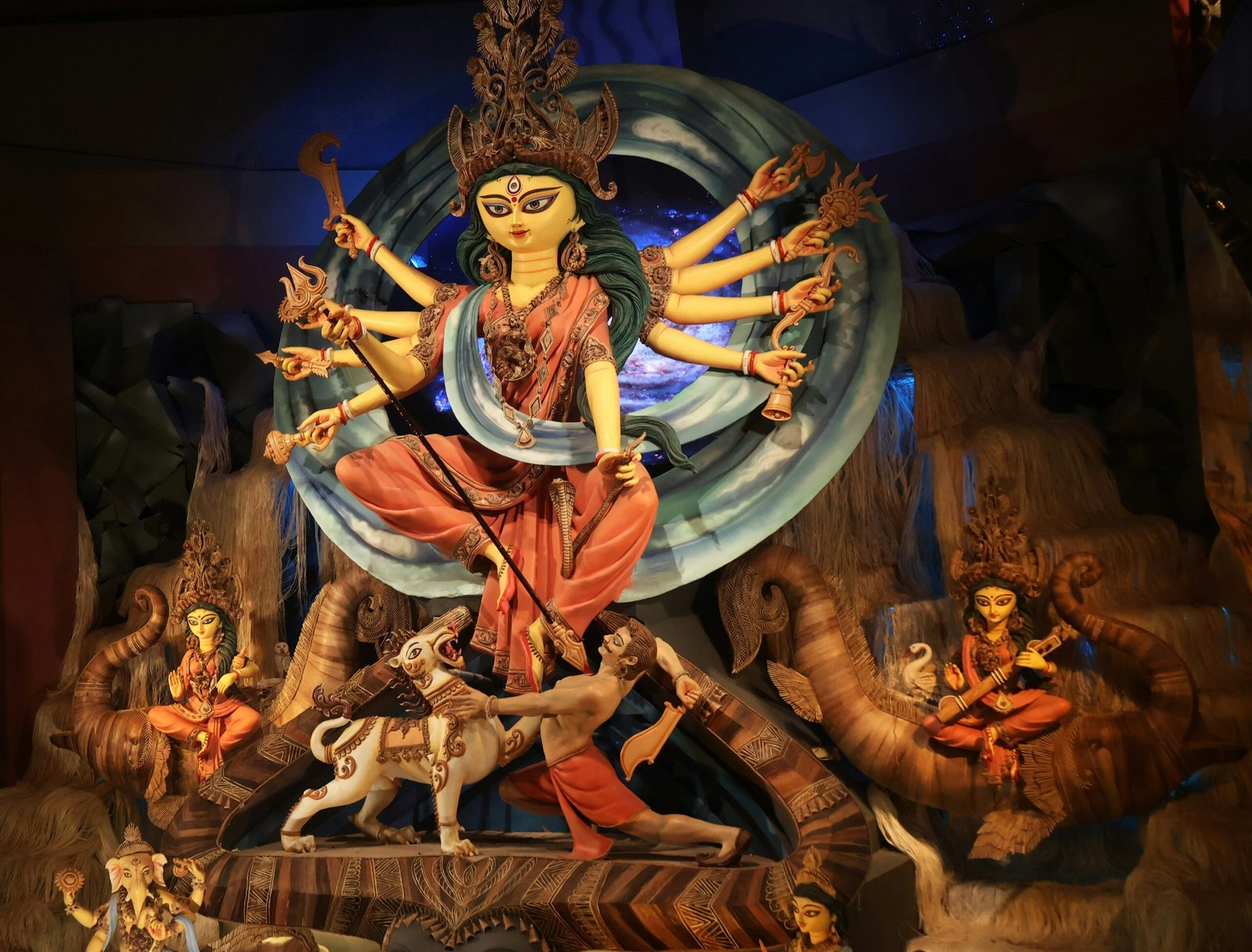
Durga Puja (UNESCO ICH 2021; Sep-Oct) transforms Kolkata into something with no parallel anywhere in India.
Over 45,000 pandals (temporary shrines, each housing a commissioned sculptural installation of Goddess Durga and her family) are constructed across the city and Bengal, each with a unique artistic concept conceived by a creative director, designed by artisans, and funded by neighbourhood committees.
The Puja is simultaneously a religious event, a city-wide art exhibition, a street festival, and a community gathering, and it operates at a scale that defeats any single itinerary.
The pandal-hopping tradition is the correct way to experience it.
Durga Puja is the occasion that defines the Bengali social and culinary calendar; the bhog (community meal distributed freely at every pandal, khichuri with labra and chutney, sometimes with ilish paturi (fish) on Saptami – yes you heard that right) is served not as restaurant food but as prasad given from the goddess’s offering to everyone present.
Baul Music the Wandering Mystic Tradition
The Baul tradition (UNESCO ICH 2008) of Bengal is a syncretic mystical practice, neither fully Hindu nor Muslim, rejecting caste and formal religious structure.
Finding the divine in the human body and in direct experience, expressed through music, poetry, and a wandering mendicant lifestyle.
The ektara (one-string instrument), the dotara, and the duggi drum are the primary instruments; the performance is not staged entertainment but a philosophical act.
The Baul fair at Kenduli (Birbhum district; Makar Sankranti, mid-January; at the birthplace of 12th-century poet Jayadeva) is the largest annual gathering of Baul and Fakiri musicians in Bengal.
A multi-day convergence of practitioners camping on the banks of the Ajoy River, performing through the night, with minimal tourist infrastructure and maximum cultural authenticity.
Attending requires being at Kenduli during Makar Sankranti; no tickets, no stages – just musicians under the trees and by fires.
Chhau Dance of Purulia, the Minimal-tourist-footprint Festival
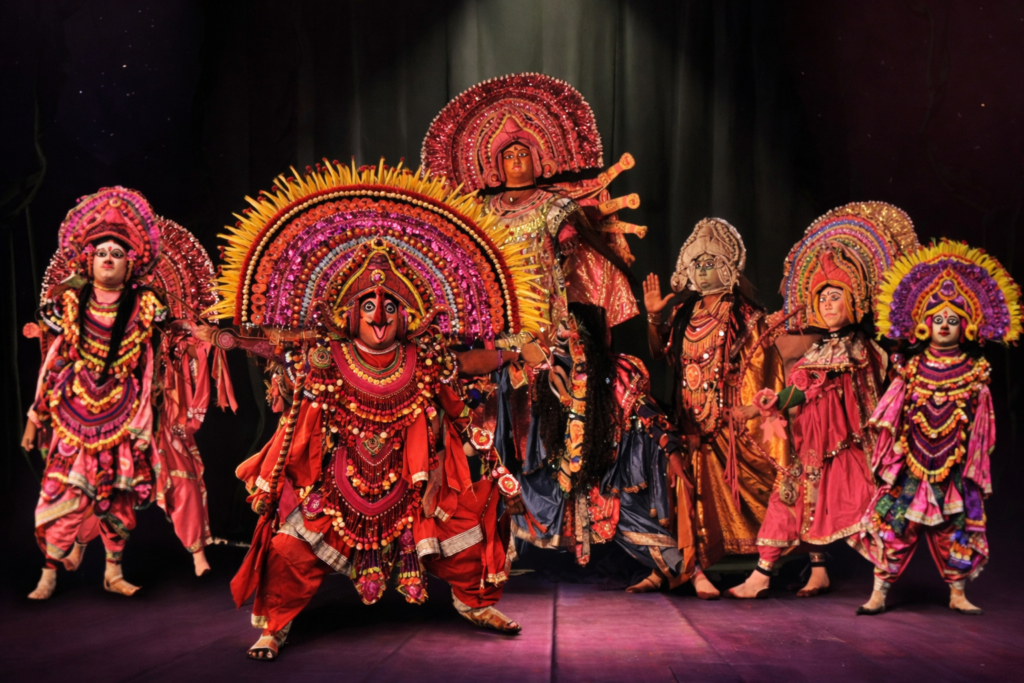
The Chhau masked dance of Purulia (UNESCO ICH 2010; the West Bengal variant of a tradition shared with Jharkhand and Odisha) is performed at the Chaitra Parba festival (Mar–Apr; exact dates per Bengali lunar calendar; the last two nights of Chaitra month) in village settings across Purulia district.
The performance depicts scenes from the Mahabharata, Ramayana, and Puranic stories through highly physical masked dance requiring years of training.
The Purulia variant uses the most elaborate masks of the three regional Chhau styles – painted in vivid reds and golds; the face of Mahishasura, the demon, requires a mask of specific proportions traditional to this region.
The Chaitra Parba is a village event, not a cultural production: attending requires advance coordination with Purulia district tourism or a local cultural organisation, and the experience is as a guest of the community, not an audience member.
Santiniketan
The Bengal Renaissance (approximately 1820s–1940s), the period of social reform, literary achievement, and cultural reinvention centred in Kolkata and its educational institutions produced Rabindranath Tagore (the only Asian to win the Nobel Prize for Literature; 1913), Rammohan Roy (the social reformer who campaigned against Sati), Swami Vivekananda, and several of the intellectual architects of Indian independence.
Tagore’s Santiniketan was founded as a school in 1901, expanded to Visva-Bharati University in 1921. It was the physical expression of his educational philosophy: learning through direct engagement with nature, art, music, and craft.
The campus today holds his residence (Uttarayan complex), the open-air classrooms still in use, and the Sangit Bhavana (music faculty) where Rabindra Sangeet (Tagore’s songs over 2,000 compositions) recognised as one of the great bodies of Bengali-language music is taught and performed.
Craft and Artisan Heritage
West Bengal’s GI-registered craft traditions are among the most geographically specific in India.
Murshidabad silk was traded to Mughal courts and European markets; weavers still work on handlooms in the lanes behind the Hazarduari Palace.
Bishnupur terracotta (the Malla dynasty temples of Bishnupur, 17th–18th century; the tradition of firing temples from the same terracotta as pottery; the craft still practised in the Panchmura village.
Kantha embroidery – the folk embroidery tradition of recycled sari cloth; running-stitch geometric and narrative panels (particularly from Birbhum and Murshidabad),
Darjeeling Tea (the first GI tag ever issued in India; 2004–05) are the headline GI traditions.
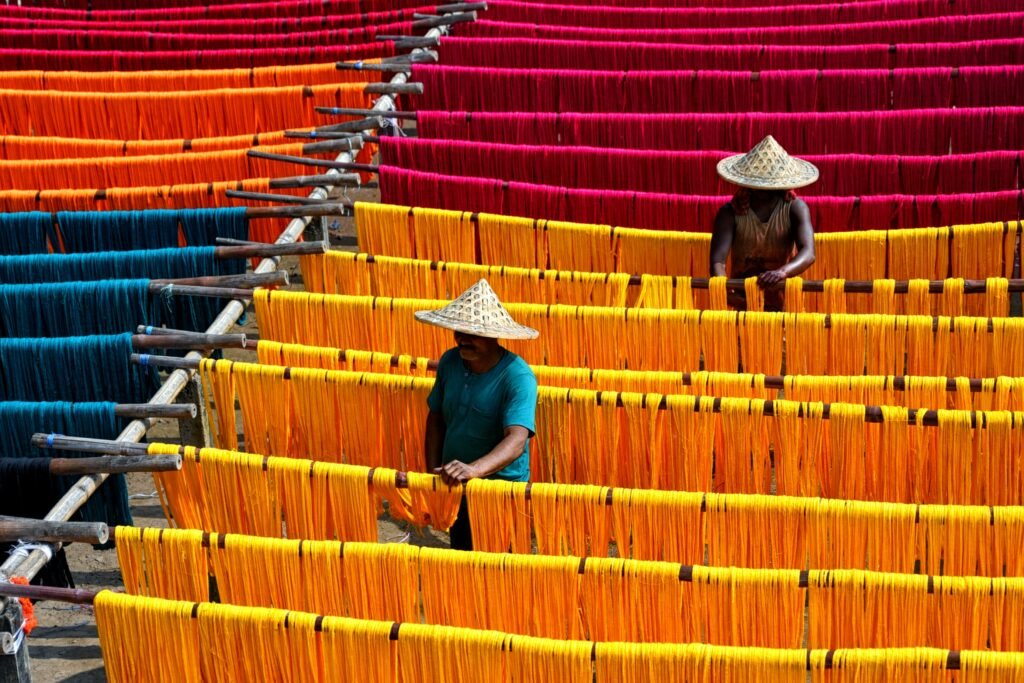
Bring home: Murshidabad silk stoles, Kantha-embroidered panel or garment, terracotta jewellery from Bishnupur artisan cooperatives and Darjeeling tea.
Food Trail
Bengal’s culinary character is anchored in fish. The saying – “Machhe Bhate Bangali” (fish and rice makes a Bengali) is not metaphorical; it is a dietary statement.
The Hilsa (Ilish) the king fish of Bengal, migratory, caught in the Ganga-Brahmaputra estuaries from Jul–Sep; the flesh fatty, the bones fine, the flavour irreplaceable to the Bengali palate is the most culturally significant.
The Bengali thali at its full expression is a sequenced meal that runs from fried fritters, bitter potage shukto, through dal, multiple fish preparations, and ends in mishti doi and sweets.
The occasion that summons the full thali is the community gathering: the Puja bhog, the wedding feast, the family homecoming, the meal is always in service of the gathering that precedes it.
Street Food Vocabulary
Kathi roll, rolled paratha wrap with egg and meat filling; invented at Nizam’s restaurant, Kolkata, 1930s; now replicated globally but only authentic at its source,
Phuchka (Kolkata’s version of pani puri; the tamarind water is sourer, more complex; the filling includes tamarind-mashed potato), Ghugni (dried yellow peas in a spiced gravy; available at street corners across Bengal), and, Tele-Bhaja (cutlets made of veg, egg, prawns or meat) to name few.
Bengal’s sweet tradition is among the most technically sophisticated in India. (Exact GI tag count – verify at gimsme.wb.gov.in)
Rasgolla (the syrup-soaked chhena dumpling; the GI tag for the West Bengal variant, Sandesh, Mishti Doi needs no brief, Langcha (GI-tagged), eaten warm the Langcha stalls at Shaktigarh are a mandatory highway stop for anyone driving between Kolkata and Bardhaman.
The Best Season to Experience West Bengal
Hills (Darjeeling, Sandakphu, Singalila):
| Month | Conditions | Best for |
|---|---|---|
| Oct–Nov | Crystal mountain views; post-monsoon clear; cold nights | Trekking (peak); Astrophotography; Kangchenjunga dawn views |
| Mar–Apr | Rhododendron bloom; first-flush tea; warming | Tea estate immersion; Spring trekking; Paragliding |
| Dec–Feb | Cold; Sandakphu possible with gear; occasional snow on ridge | Winter trekking; Snowfall photography; Darjeeling quiet season |
| Jun–Sep | Heavy monsoon; most mountain routes close | Avoid trekking; monsoon Darjeeling still visitble with flexibility |
Plains, Dooars, Sundarbans, and Heartland:
| Month | Zone | Best for |
|---|---|---|
| Oct–Nov | All plains zones | Durga Puja (Oct); Post-Puja cultural circuits; Dooars wildlife; Sundarbans |
| Dec–Feb | Dooars, Sundarbans, Heartland | Peak wildlife (Dooars, Sundarbans); Baul fair at Kenduli (Jan); Poush Mela Santiniketan (Dec); Bishnupur Mela (Dec) |
| Mar–Apr | Heartland, Purulia | Basanta Utsav Santiniketan; Chaitra Parba / Chhau in Purulia; Gangasagar post-season |
| Jul–Aug | Kolkata, Heartland | Ilish (Hilsa) season peak; best Bengali fish cuisine; Kolkata monsoon cultural life |
| Jun–Sep | Sundarbans | Cyclone season; restricted access; avoid |
The October combination: The only month that delivers Sandakphu trekking peak (clearest mountain views) and Durga Puja in Kolkata simultaneously.
A 10-day trip holds both – 5 nights on the ridge, then 5 nights in Kolkata for Puja. No other month offers this.
Getting to West Bengal
| Mode | From | Route and approx time |
|---|---|---|
| Air – Kolkata CCU | Delhi, Mumbai, Bengaluru, and all metros; international connections | Primary international gateway; Delhi ~2 hrs; Mumbai ~2.5 hrs |
| Air – Bagdogra IXB | Kolkata, Delhi, Mumbai | Essential north Bengal gateway (Darjeeling, Dooars, Sikkim approach); Kolkata ~1 hr |
| Rail – Howrah / Sealdah (Kolkata) | Delhi, Mumbai, Chennai, all metros | Kolkata from Delhi ~17 hrs (Rajdhani); Mumbai ~26 hrs; western and eastern routes split between Howrah and Sealdah junctions respectively |
| Rail – New Jalpaiguri NJP | Kolkata, Delhi, Mumbai | Mainline railhead for all north Bengal; Kolkata to NJP ~8–10 hrs |
| Road from Kolkata | Within state | NH12 / NH27 north to Siliguri (~600km; 10–12 hrs); NH16 east–west to coastal belt |
Note on international connectivity gap: Despite 3.12 million foreign arrivals in 2024, Kolkata receives only 51 international flights daily against Mumbai’s 516 and Delhi’s 590.
Most international visitors connect through Mumbai or Delhi. This gap is a known editorial context, not a deterrent but a planning fact.
Moving Within West Bengal
| Route | Fastest mode | Approx time |
|---|---|---|
| Kolkata to Siliguri / NJP | Train (Vande Bharat / express) | 8–10 hrs |
| Kolkata to Darjeeling | Train to NJP + road | 11–13 hrs total |
| Kolkata to Santiniketan (Bolpur) | Train (Shantiniketan Express) | 2.5–3 hrs |
| Kolkata to Sundarbans (Godkhali) | Road + ferry | 2.5–3 hrs + 30 min boat |
| Siliguri to Darjeeling | Hill road | 3 hrs (or 7–8 hrs by DHR toy train) |
| Siliguri to Jaldapara / Dooars | Road | 2–3 hrs |
| Siliguri to Kalimpong | Road | 2.5 hrs |
Hill road reality: Do not plan north Bengal itineraries by distance. Average speed on single-lane hill roads is 25–30 km/hr.
Add 1–2 buffer days during and immediately after monsoon for landslide clearance on the Siliguri–Darjeeling corridor.
Sundarbans: No roads inside the reserve. All movement by boat through tidal channels.
The tidal schedule governs departure times not the clock. Request the tidal calendar from your operator at the time of booking.
Kolkata: The Howrah–Kolkata ferry across the Hooghly is the most atmospheric river crossing.
Metro is significantly faster than road during peak hours (9–11am, 5–8pm). Fun-fact: India’s only functioning (ornamental now) tram network (since 1880) and its first metro (1984).
What Explorers Ask for Experiences in West Bengal – FAQ
What are the experiences in West Bengal worth exploring?
West Bengal is unusually strong in adventure, cultural immersion, wildlife and nature; but the answer depends on what kind of travel you value most.
For adventure, Sandakphu, Singalila, rafting on the Teesta, paragliding, off-roading, and motorbike loops in the Himalayan foothills give the state real depth.
For cultural immersion, West Bengal is arguably one of the strongest states in India because it offers Durga Puja, Baul music, Santiniketan, Bengal Renaissance history, living craft traditions, and one of the country’s richest food cultures.
For wildlife and nature, the state is distinctive because it offers very different habitats in one geography: mangrove wildlife in the Sundarbans, rhino country in the Dooars, red panda habitat in Singalila, and serious birding across multiple ecosystems.
If you want one word, West Bengal is best for explorers who like overlap, where adventure, culture, and nature do not sit in separate boxes.
What is the best time to visit West Bengal for trekking, wildlife, and festivals?
The best time depends on what you want to prioritise. For trekking in Sandakphu and Singalila, October to November is the clearest and strongest window, while March to April is excellent for rhododendrons, first-flush tea, and spring trekking.
For wildlife, December to February is the strongest overall season for the Dooars and the Sundarbans, with October to January also working well in many wildlife zones.
For festivals and cultural exploration, October is best for Durga Puja (the date varies every year, check exact dates before planning), December for Poush Mela in Santiniketan, January for the Kenduli Baul fair, and March to April for Basanta Utsav and Chhau-linked seasonal travel.
If you want one especially powerful combination, October is the standout month because it can bring together Sandakphu, Kolkata during Puja, post-monsoon clarity, and strong plains travel conditions.
What is the best base for trekking in Sandakphu, West Bengal?
Manebhanjyang (26km from Darjeeling; 2,134m) is the actual trailhead for the Sandakphu route, all GTA huts, permit checkposts, and jeep arrangements originate here.
Darjeeling is the convenient hub for acclimatisation, logistics, and the DHR experience. The standard approach is 1–2 nights in Darjeeling, then move to Manebhanjyang (or Maneybhanjyang) on Day 3.
Do not attempt to start the trek on arrival day at Darjeeling.
Do foreign nationals need special permits to trek the Sandakphu route?
Yes. Since 2022, foreign nationals are restricted to GTA-managed huts on the Indian side of the Singalila Ridge, they cannot stay in Nepalese-side properties that are also used on this route.
Verify current regulations and permit requirements at the GTA office in Darjeeling or at the Manebhanjyang checkpost before finalising your itinerary.
When exactly is Durga Puja and how should I plan around it?
Durga Puja falls in the Bengali month of Ashwin, typically October, occasionally late September.
The exact dates shift each year with the lunar calendar; Mahasaptami, Mahashtami, Mahanavami, and Vijaya Dashami are the four principal days.
Book Kolkata accommodation 3–4 months in advance for the Puja window; the city fills completely. Flights to Kolkata during Puja week are significantly more expensive.
Is the Sundarbans tiger safari reliable, will I actually see a tiger?
Tiger sightings in the Sundarbans are real but not guaranteed, and the honest answer is that the probability is lower than at Ranthambore or Kabini.
The mangrove forest is dense; the tigers move through tidal channels and between islands rather than concentrating at open waterholes.
The experience is fundamentally different from open-country tiger reserves.
The Sundarbans safari is primarily a forest encounter, with tiger evidence (pugmarks on mudbanks) as the reliable element and direct sightings as the reward.
What is the Baul music tradition and where is the best place to experience it authentically?
Baul is a Bengali mystical folk music tradition (UNESCO ICH 2008) practised by wandering singers (Bauls) who belong to a syncretic tradition that draws from both Hindu bhakti and Sufi Islam, rejecting caste and formal religious structure.
The most authentic encounter is at the Kenduli Baul fair (Birbhum district; Makar Sankranti, mid-January) where hundreds of Baul and Fakiri musicians gather at the birthplace of poet Jayadeva for a multi-day performance convergence with no tourist infrastructure.
In Santiniketan, the Visva-Bharati campus and several cultural organisations maintain the tradition year-round; the Poush Mela (December) includes significant Baul performance.
What GI-tagged products from West Bengal are worth bringing home?
The most distinctive: Darjeeling Tea (first GI tag in India; 2004–05; buy from a reputable estate directly or from a certified TEAI seller – not airport gift shops), Banglar Rasogolla fresh from Kolkata’s established mishti shops, Joynagar Moa available November–February only; buy in Kolkata winter markets, Murshidabad silk (fine woven fabric; buy directly from weavers in the lanes behind Hazarduari or from credentialled cooperative shops), and Baluchari saree (Bishnupur; intricate woven silk with mythological motifs.