
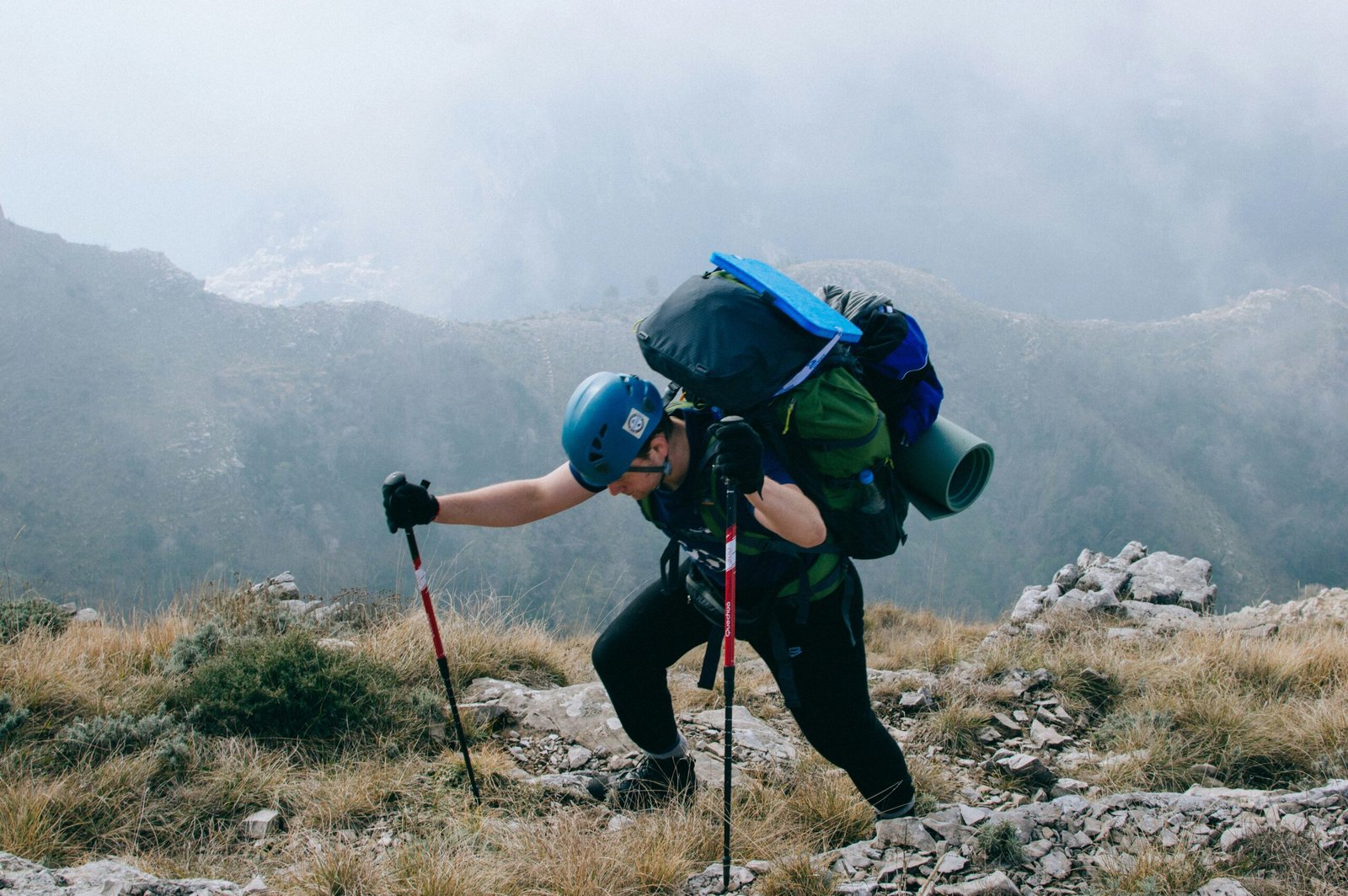
If you want to know-how if a trek is too hard for you, stop looking for easy-medium-hard ratings.

Trek difficulty is not a fixed number.

It changes depending on who is showing up at the trailhead, what their body has done before, how they recover across consecutive days, and whether altitude is a familiar stressor or a complete unknown.
This trek fitness score guide helps you judge that honestly.
It breaks readiness into the variables that matter most – altitude exposure, fitness baseline, previous trekking experience, load-carrying, and itinerary design. So next time you can tell the difference between a stretch that builds you and a booking that sets you up badly.
Why Trek Difficulty Has Two Sides and Most Trekkers Only Read One
GDT developed the TFS (Trek Fitness Score) rating to answer the right question.
It assesses both the trek and the trekker.
This guide walks you through that assessment – how to rate yourself honestly, how to read a TFS rating on a trek;
And what to do if the score you get is not the one you wanted.
Every trek mentioned on GDT carries a TFS rating. It is produced by evaluating two things simultaneously.
Side 1 – What the Trek Demands
Five parameters define a trek’s objective demands:
Maximum altitude reached: The single most consequential variable. Above 3,000m, the atmosphere thins perceptibly.
Above 4,000m, most people feel altitude’s effects without acclimatisation.
Above 5,000m, the body’s oxygen processing is under sustained stress regardless of fitness.
Daily elevation gain: How many metres you climb each day.
A 15km flat trail is categorically different from a 15km trail with 1,200m of ascent.
Sustained elevation gain, day after day, is where cardiovascular base matters most.
Daily distance: Raw kilometres walked. At altitude, 15km can feel like 25km at sea level.
Distance compounds with gradient and thin air.
Terrain type: A maintained trail with clear waymarking is a TFS1 terrain variable.
A loose scree approach with no path markers is a TFS3 variable.
A glacier crossing with crevasse risk is TFS4 regardless of the altitude. What you walk on determines pack requirements, pace, and fall risk.
Available support: A route with teahouses every 3km, a helicopter evacuation option, and clear mobile connectivity is structurally different from a remote wilderness route where the nearest help is two days’ walk away.
Side 2 – What you Bring
Four parameters define your readiness:
Prior multi-day trekking experience: Not hiking – trekking. Multi-day carrying a pack, sleeping away from home, managing cumulative fatigue.
The body learns how to recover across days of effort.
This learning happens on trail, not in a gym.
Cardiovascular fitness baseline: Your aerobic engine.
The single best proxy for most trekkers is: how far and how fast can you walk uphill for 5 hours without stopping?
If you cannot answer this, the trail will answer it for you.
Altitude exposure history: Have you slept above 3,000m before?
Above 3,500m? Your body’s acclimatisation history is a meaningful predictor of how you will respond to altitude again.
First exposure at altitude is always the least predictable.
Load-carrying capacity: Multi-day trekking requires carrying a pack.
At TFS2, that pack is 8–10kg. At TFS3, 12–15kg. At TFS4, 18–22kg or route-appropriate porter support.
Your fitness at body weight is not the same as your fitness with 15kg on your back after 6 days on trail.
How GDT Rates a Trek: The Trek Fitness Score Rating
This section explains how every TFS grade on GDT is produced.
Understanding the methodology tells you what a TFS2 actually means in objective terms, and why a TFS2-3 span means something specific rather than “we weren’t sure.”
Every trek’s TFS grade is derived from the same five parameters described above.
The process runs in two stages: anchor rating, then modifier assessment.
Stage 1: Anchor Rating (Altitude and Elevation Gain)
Maximum altitude and daily elevation gain are the two primary anchors of the TFS rating.
They receive the highest weight because altitude is the variable most likely to exceed a trekker’s physiological ceiling regardless of fitness, and daily elevation gain is the variable most directly tied to cardiovascular demand over consecutive days.
| Max altitude reached | Typical daily elevation gain | TFS anchor |
|---|---|---|
| Below 2,500m | Under 400m per day | TFS1 |
| 2,500m–3,500m | 400–700m per day | TFS2 |
| 3,500m–5,000m | 600–1,000m per day | TFS3 |
| 5,000m and above | Sustained; 500–800m per day at altitude | TFS4 |
The anchor is not a formula – it is a starting point.
A trek where the maximum altitude is 3,200m but the daily elevation gain averages only 250m across a long, low-gradient approach receives a TFS2 anchor.
A trek where the maximum altitude is 3,400m but every day involves 900m of sustained ascent from a lowland camp receives a TFS2-3 anchor at the start of Stage 2.
Daily Distance as a Secondary Anchor Factor:
Daily distance adjusts the anchor when it diverges significantly from what is typical for the altitude level. These are the distance bands that inform each TFS level:
| TFS level | Typical daily distance range |
|---|---|
| TFS1 | 8–14km per day |
| TFS2 | 10–16km per day |
| TFS3 | 12–20km per day |
| TFS4 | 8–18km per day sustained across consecutive high-altitude days |
A trek whose altitude and elevation gain anchor it at TFS2 but whose daily distances consistently run at 18–20km receives a TFS2-3 consideration.
A TFS4 trek whose daily distances are short (8–10km) but whose altitude is sustained above 5,000m for multiple consecutive nights is rated firmly TFS4 on altitude alone – the short distance does not reduce the demand.
Stage 2: Modifier Assessment (Terrain type and Available Support)
After the anchor rating is established, terrain type and available support are assessed as modifiers.
Each can adjust the anchor rating by up to one level – but only when the parameter is meaningfully outside the typical range for that altitude level.
Terrain Type Modifier:
The terrain type at a given altitude level is assessed against what is standard for that level.
A well-marked trail on compacted earth is standard terrain at any TFS level.
The modifier triggers when the terrain is significantly more demanding than standard:
| Terrain condition | Modifier |
|---|---|
| Maintained trail, clear waymarking, compacted surface | Standard — no adjustment |
| Significant loose surface (scree, gravel), partial waymarking, some route-finding | +0.5 — pushes toward upper boundary or span |
| Unmarked, sustained loose or technical terrain, navigation required throughout | +1 — pushes anchor up by one level |
| Glacier approach, snowfield crossing, fixed rope sections (crampon territory) | Approaches TFS4 ceiling regardless of altitude anchor |
Available Support Modifier:
Available support is assessed against what is typical for the altitude level.
A route with teahouse infrastructure and helicopter evacuation access is standard for commercial trekking at all TFS levels.
The modifier triggers when support is significantly lower than standard:
| Support condition | Modifier |
|---|---|
| Teahouses or established camps, mobile connectivity on most sections, helicopter evacuation accessible | Standard — no adjustment |
| Camping required for some sections, mobile connectivity intermittent, evacuation 4–8 hours from most points | +0.5 — pushes toward upper boundary or span |
| Fully self-supported camping, no mobile connectivity, evacuation more than one day from most points | +1 — pushes anchor up by one level |
The Span Rating – What TFS2-3 Means Precisely
A trek receives a span rating when:
The anchor falls at the boundary of two levels – altitude or elevation gain places it between the standard ranges;
Neither level is a clean fit. Sandakphu at 3,636m sits exactly at the boundary of TFS2 (below 3,500m) and TFS3 (above 3,500m).
The elevation gain across the standard route is moderate.
The terrain is a maintained ridge trail. Available support through GTA huts is adequate.
Anchor: TFS2-3 boundary. No modifiers trigger. Result: TFS2-3.
A specific section within the route sits at a higher level than the main route – the pass crossing, the summit day, or a demanding descent that sits at the upper level while the rest of the route sits at the lower.
Roopkund at 5,029m has a summit day (Bhagwabasa to Roopkund and return) that is TFS3-4 in demand while the approach stages are TFS3.
The overall rating is TFS3-4.
A modifier pushes the anchor to the boundary without fully crossing it – the anchor is TFS2 but terrain or support conditions are meaningfully below standard without reaching the full +1 threshold.
The route is harder than a clean TFS2 but does not yet carry the sustained demand of TFS3.
How to use a span rating as a trekker: If your self-assessment (below) produces a score at the lower level of the span, read the route description carefully for the section that drives the upper level.
Prepare for that section specifically, not just for the average of the route.
If a longer itinerary option exists, choose it – more days almost always means better acclimatisation and more manageable daily effort.
A Worked Example – How Sandakphu Gets its TFS2-3
Sandakphu (3,636m; Singalila Ridge, West Bengal; standard route 5–7 days from Manebhanjyang):
| Parameter | Assessment | Weight |
|---|---|---|
| Maximum altitude | 3,636m — at the TFS2/TFS3 boundary | Primary anchor |
| Daily elevation gain | 400–700m on approach days; one demanding gain day to the summit | Primary anchor |
| Daily distance | 12–16km per day — within TFS2-3 band | Secondary |
| Terrain type | Maintained GTA ridge trail; clear waymarking throughout; compacted earth | Standard — no modifier |
| Available support | GTA huts at all major stages; BRO outposts; mobile connectivity on most sections | Standard — no modifier |
Anchor: TFS2-3 boundary (altitude sits exactly at the boundary; elevation gain is moderate TFS2-3). No modifiers trigger. Result: TFS2-3.
Interpretation: A trekker at the strong end of TFS2 with prior nights above 3,000m completes this comfortably.
A trekker at the entry level of TFS2 with no altitude history should treat it as TFS3 in their preparation – adding acclimatisation time and building to the upper end of the TFS2 fitness benchmarks before departing.
Where are You Now? Do a Self Assessment Before You Book
Work through this honestly to find your TFS, before the trail does it for you.
The point is not to find the highest TFS you can claim.
The point is to find the TFS that matches your current state and then either match it to the right trek, or train to close the gap.
Step 1: Your Altitude History
Answer each question about your altitude history:
| Question | Your answer |
|---|---|
| What is the highest altitude you have slept at? | |
| Did you experience symptoms at that altitude? (headache, nausea, fatigue, disrupted sleep) | |
| How many nights above 3,000m have you accumulated total? | |
| Have you ever been diagnosed with AMS (Acute Mountain Sickness)? |
Interpreting Your Altitude History:
Never above 1,500m: Your altitude response is unknown.
This is a significant variable at TFS3 and above. Plan conservatively, build in extra acclimatisation days and do not book a non-refundable itinerary that has no flexibility to slow down.
1–3 nights above 3,000m with no symptoms: Good baseline. You respond reasonably well.
TFS3 treks are within reach with appropriate acclimatisation protocols.
Multiple nights above 3,500m without symptoms: Strong altitude history.
TFS3 appropriate; TFS4 accessible with fitness and expedition preparation.
History of AMS at any altitude: This does not disqualify you from altitude trekking. Many with prior AMS have successful high-altitude treks with adjusted protocols.
It does mean: consult a travel medicine doctor before any TFS3+ trek, discuss prophylactic options, and choose itineraries with maximum acclimatisation days built in.
Step 2: Fitness Baseline
The most honest test is a loaded hill walk.
If you can do it, do it. If you do not know your cardiovascular baseline, estimate from the questions below.
The benchmark walk: 5 hours continuous uphill walking, 800–1,000m elevation gain, with a 10kg loaded pack. Note your heart rate response, recovery time, and whether you could have done it again the next day.
If you cannot access a hill for this test, work through these proxies:
| Fitness marker | TFS1 | TFS2 | TFS3 | TFS4 |
|---|---|---|---|---|
| Comfortable walking distance (flat, no pack) | 8–10km | 15km | 20km+ | 25km+ |
| Stair climb (continuous, no rest) | 5 floors | 15 floors | 30 floors | 50+ floors |
| Regular exercise frequency | Walking | 2–3x/week cardio | 4–5x/week; includes hills | Daily training; structured programme |
| Can carry 10kg pack for 4 hours? | No | Yes, flat terrain | Yes, hills | Yes, extended days |
| Recovery after hard day (walking 15km+) | 2+ days | 1–2 days | Same day | Next morning |
Be honest with the “comfortable” column. Comfortable means you could do it again the next day.
Step 3: Prior Trekking Experience
| Prior Trekking Experience | TFS credit |
|---|---|
| No multi-day trekking; day hikes only | TFS1 baseline |
| 1–2 multi-day treks (2–3 days each); no altitude | TFS2 baseline |
| 3+ multi-day treks; at least one above 3,000m | TFS2–3 |
| Multiple TFS2–3 treks completed; familiar with altitude | TFS3 baseline |
| Multiple TFS3 treks above 4,000m; overnight at altitude | TFS3–4 |
| TFS4 treks completed; glacier or technical terrain experience | TFS4 |
Importance of Prior Trekking Experience: Each level builds on the previous one in ways that cannot be skipped.
You cannot reliably perform at TFS3 without TFS2 experience in your body.
The trail teaches things that training cannot.
Step 4: Find Your Trek Fitness Score
While measuring your TFS level, take the lowest of the three assessments above (altitude history, fitness baseline, trekking experience). That is your current effective TFS.
Why the lowest? Because the mountain does not average your strengths.
If you are TFS3 fit but have never been above 1,500m, your altitude response is the unknown that controls your outcome.
If you have strong altitude history but TFS2 fitness, the sustained effort will catch up with you on day 5 or 6. The constraint is always the weakest variable.
How to Read a TFS Rating? The TFS Grade Marked on Every Trek on GDT
Every trek mentioned on GDT and Trip Planners carries a TFS rating. Here is how to use it:
Single TFS grade (e.g. TFS2): The trek is designed for trekkers at this level.
If your self-assessment produces TFS2 or above, you are ready.
If your self-assessment produces TFS1, this trek will be harder than comfortable – either prepare (see training section below) or choose a lower TFS option.
Two-level span (e.g. TFS2–3): The trek transitions between difficulty levels, usually because one section (a high-altitude pass, a long summit day, a demanding descent) sits at the upper level while the rest of the route sits at the lower level.
If your self-assessment is at the lower level (TFS2), read the Trip Builder description of the transition section carefully.
If you are confident and have been building consistently, you may be ready. If you are at the exact boundary, choose the longer itinerary option if one exists – more days almost always means better acclimatisation and more manageable daily effort.
Effective TFS Adjustment for Unacclimatisation: If you are arriving at a trek fit but without recent altitude exposure, add one level to the effective difficulty.
An TFS3 trek becomes TFS4 in practical demand for an unacclimatised trekker, regardless of fitness.
This is why itinerary acclimatisation days, rest days at altitude before ascending further, are not optional extras on TFS3+ treks.
They are the mechanism that keeps the effective TFS manageable.
Worked Examples – Three Trekkers, Three Decisions
Trekker A – Priya, 34, Bengaluru: Background: Runs 5km three times a week. One overnight camping trip in Coorg. Never above 1,200m. Planning to do Kedarkantha (3,800m, 5–6 days, TFS2).
Assessment:
- Altitude history: Never above 1,200m. Response unknown. Risk: significant.
- Fitness: 3x/week cardio, no hills. Carries 10kg for short distance. → TFS1–2 boundary.
- Trekking experience: One overnight, no altitude. → TFS1 baseline.
- Effective TFS: TFS1–2. Kedarkantha is TFS2.
Decision: Kedarkantha is achievable but requires specific preparation – 8 weeks of hill-loaded training, a reconnaissance night at moderate altitude (a hill station above 2,000m if possible), and a 6-day itinerary (not 5) with the maximum acclimatisation time.
If Priya cannot do the preparation, Triund (2,850m, 2-3 days, TFS2) is the right entry point this year and Kedarkantha next year.
Outcome if she goes unprepared: High probability of moderate AMS on Day 3 (3,400m camp) requiring descent. Not a health catastrophe but a failed trek.
Trekker B – Rohit, 28, Delhi: Background: Cycles 80km/week. Trekked Kedarkantha twice. One night at 3,600m. Planning Everest Base Camp (5,364m, 12–14 days, TFS3).
Assessment:
- Altitude history: One night at 3,600m, no symptoms. → Reasonable TFS2–3 altitude baseline.
- Fitness: Cycling is excellent cardiovascular base. Hill-loaded walking less established. → TFS3 fitness with a gap: cycling does not prepare legs for descent.
- Trekking experience: Two TFS2 treks completed. → TFS2–3.
- Effective TFS: TFS2–3. EBC is TFS3.
Decision: Rohit is at the threshold. He is ready if he adds 10–12 weeks of loaded hill walking to his cycling training, specifically downhill loaded descents, which cycling does not develop.
He should choose a 14-day EBC itinerary (not 12) and build in the full Namche acclimatisation day.
Going on the 12-day itinerary without specific descent training is the plan most likely to end in knee failure on Day 10.
Outcome if he goes well-prepared: Strong TFS3 trekker with excellent cardiovascular base. Likely to have a good summit experience.
Trekker C – Anjali, 45, Mumbai: Background: Yoga practitioner, walks 8km daily, no prior trekking. Interested in Sandakphu (3,636m, 5 days, TFS2).
Assessment:
- Altitude history: Never above 800m. Response unknown.
- Fitness: Daily walking, yoga flexibility, no cardiovascular intensity. → TFS1 fitness.
- Trekking experience: None. → TFS1 baseline.
- Effective TFS: TFS1. Sandakphu is TFS2.
Decision: Sandakphu is a 1-level stretch from Anjali’s current TFS1 baseline.
Entirely achievable with 10 weeks of progressive loaded walking (starting at 45 min, building to 3-hour hill walks with a 6–8kg pack).
The 5-day standard itinerary is appropriate; the jeep-assisted variant (same summit, TFS1–2) is the right fallback if training cannot be completed.
No need to wait, the preparation is accessible without specialist fitness infrastructure.
Outcome if she prepares: Sandakphu is a genuinely life-altering first trek for the right person. Anjali’s yoga background gives her body awareness that most beginners lack – a real asset at altitude for breathing management.
The Trek Training That Prepares You for the Next Trek – by TFS Grading
Training for trekking is not complicated. It is specific, and most people train for the wrong thing (intensity, not duration; gym, not hills; speed, not load).
The two things that matter most:
Duration over intensity. Trekking is sustained aerobic effort across multiple hours, multiple days.
Your training should involve long sessions (2–5 hours) more than short intense ones.
A 4-hour loaded hill walk does more for trek preparation than four 1-hour gym sessions.
Hill-loaded walking, not flat running. Running improves cardiovascular capacity but does not train the specific muscle chains – hip flexors, quads on descent, calf and ankle stabilisers, that trekking demands.
Add gradient and load as the primary variables.
Training Frameworks by TFS Target
TFS1 Training Target (8 weeks):
Weeks 1–4: 3 × 45-min walks per week, moderate pace. One weekend walk 2 hours.
Weeks 5–8: 3 × 60-min walks. One weekend walk 3 hours with a 3–4kg daypack.
Fitness test: Walk 12km in 3 hours with a 4kg pack on varied terrain. If comfortable, TFS1 ready.
TFS2 Training Target (8–12 weeks):
Weeks 1–4: 4 × sessions/week; 2 × 60-min cardio (cycling/stair/hill walk) + 2 × strength (lower body – squats, lunges, step-ups, calf raises).
Weeks 5–8: Add loaded walking sessions. 2 × loaded walks per week; start 6kg pack, build to 8–10kg. Weekend walk 3–4 hours with load and gradient.
Weeks 9–12: One overnight camping or hill station stay. Full-day loaded walk (6+ hours). Test: 15km with 600m elevation gain and 8kg pack. If manageable, TFS2 ready.

TFS3 Training Target (12–16 weeks):
Weeks 1–4: Establish cardiovascular base. 5 × sessions/week; includes 2 × long sessions (2+ hours).
Weeks 5–8: Hill-loading. 3 × loaded hill sessions/week; build pack to 12–15kg.
Seek sustained ascents of 400–600m.
TFS4 Training Target (16–20 weeks):
The TFS4 training programme is a structured athletic preparation requiring consistent daily effort across 4+ months.
It goes beyond the scope of a brief framework, it involves periodised cardiovascular base, strength specificity, loaded multi-day back-to-back sessions, and a prior TFS3 trek as a mandatory prerequisite.
Consult the specific TFS4 Trip Planner for your chosen trek – each TFS4 destination carries a preparation section tailored to its altitude profile and duration.
Engaging a certified trekking fitness coach for TFS4 preparation is strongly recommended.
Altitude Illness: The Facts That Every Trekker Needs Before 3,500m
This is not optional reading. Altitude illness kills trekkers who do not understand it – not because it is unavoidable, but because they do not recognise it or respond to it correctly.
What causes altitude illness: At altitude, reduced atmospheric pressure means each breath contains less oxygen.
Below 2,500m, this is not a problem for most people.
Between 2,500m and 3,500m, the body begins adapting, producing more red blood cells, adjusting respiratory rate.
Above 3,500m, the adaptation demand is significant. If ascent is faster than the body’s adaptation rate, illness results.
Altitude Sickness – What Every Trekker Must Know
Acute Mountain Sickness (AMS): The most common form. Headache – often described as a tight band around the forehead, plus one or more of: nausea, fatigue, dizziness, disrupted sleep. AMS is a warning, not an emergency, if caught early.
High-altitude Cerebral Oedema (HACE): AMS that progresses to brain swelling. Severe headache, loss of coordination, confusion, difficulty walking a straight line. This is an emergency. Descend immediately.
High-altitude Pulmonary Oedema (HAPE): Fluid in the lungs. Breathlessness at rest, persistent cough, pink frothy sputum, cyanosis (blue lips). This is the most dangerous form and can kill within hours. Descend immediately.
The One Rule That Prevents Most Disasters
Never ascend with symptoms.
AMS headache that you sleep through and ignore, hoping it resolves by morning, is how mild AMS becomes HACE. T
he rule is absolute: if you have AMS symptoms, you do not ascend further until they resolve completely. If they worsen, you descend.
The treatment: For AMS – rest at the same altitude, hydrate, allow 24 hours for symptoms to resolve. For HACE or HAPE – immediate descent of 300–1,000m. No exceptions.
Altitude Sickness Preventative Strategies
Ascend slowly. The standard guideline above 3,000m is: increase sleeping altitude by no more than 300–500m per day.
Build in rest days. A rest day at altitude, walking around but not ascending, is an acclimatisation day.
The standard EBC itinerary’s Namche rest day exists specifically for this purpose.
Hydrate consistently. Dehydration accelerates AMS onset. 3–4 litres per day at altitude, with electrolytes.
Diamox (acetazolamide): A medication that aids acclimatisation by stimulating breathing rate. Widely used by trekkers on TFS3+ routes. Consult your doctor before departure, it requires a prescription, has contraindications, and the right dosage depends on your medical history.
Moving Up TFS levels – What it Takes and How Long
The TFS scale is a ladder, not a ceiling. Every experienced trekker started at TFS1.
The progression from TFS1 to TFS4 across a trekking lifetime is the arc that defines the category.
TFS1 → TFS2: 1–2 seasons. One committed multi-day trek at TFS1 level (Sandakphu jeep assisted, Triund overnight) followed by the training framework above. Most fit adults can move from TFS1 to TFS2 within one year.
TFS2 → TFS3: 2–3 years of consistent trekking, including at least two TFS2 completions and at least one night above 3,500m.
The critical gap is usually altitude history, you can train your fitness to TFS3 in 16 weeks, but you cannot compress altitude experience.
TFS3 → TFS4: A minimum of two completed TFS3 treks above 4,000m, plus the specific TFS4 training preparation.
This transition typically takes 3–5 years of committed trekking.
The expedition mindset, the ability to manage effort over 10+ consecutive days, make weather and altitude decisions with partial information, and function physically and mentally at extreme fatigue, is not a fitness threshold. It is an experience threshold.
The shortcut myth: There is no shortcut through altitude exposure.
You can arrive fitter than required, with better gear than necessary, and with more preparation than anyone on the trail, but if your body has not spent time at altitude, it will take the time it needs to adapt.
The trekkers who get evacuated on Kilimanjaro are not usually unfit. They are usually under-timed.
Common Mistakes and How to Avoid Them
Overestimating gym fitness. Cycling and gym cardio build aerobic capacity but not trek-specific strength.
The loaded descent on day 8 of EBC will find muscle groups that no gym machine addresses.
Add hills and loads to your training from week one.
Booking the shortest itinerary. More days almost always means more acclimatisation time and better outcomes, especially above 4,000m.
The cost difference between a 12-day and a 14-day EBC itinerary is minor relative to the difference in completion probability.
Trusting “I was fine last time.” Prior altitude performance at 3,500m tells you something about your response at higher altitudes.
It tells you less about your response at 4,500m.
Altitude is not linear, small increases in sleeping altitude above 4,000m produce disproportionately larger physiological demands.
Ignoring symptoms on summit day. Summit fever – the psychological pull to continue upward despite warning signs is the most common proximate cause of serious altitude illness incidents on commercially trekked routes.
The mountain will be there next season. Most trekkers who turn around on EBC summit day return and complete it the following year.
Not testing gear before the trek. New boots on day one. A sleeping bag used for the first time in −5°C. A rain jacket that has never been rained on. All of these are avoidable if you test your kit before you need it.
A Note on Trek Fitness – Age Agnostic
Trekking has no age ceiling.
The TFS score is not calibrated for a specific demographic.
What changes with age is recovery time, not capability.
An active 55-year-old with consistent training and prior altitude exposure will outperform an unfit 28-year-old on the same trail every time.
The modification for older trekkers is not the TFS rating, it is the itinerary.
More days, more rest days, and more conservative daily targets produce better outcomes than pushing to match a younger group’s pace.
Choose operators who understand this and design itineraries accordingly.
This guide is a planning framework. It is not medical advice. For altitude illness prevention, Diamox prescription, or any specific health concerns, consult a travel medicine specialist before your trek.
What People Frequently Ask About Trek Difficulty
How Do I Know if a Trek is Easy, Moderate, or Difficult?
Trek difficulty is determined by a combination of factors, including the maximum altitude reached, daily walking hours, previous trekking experience, load-carrying, cardiovascular fitness, season, the steepness of ascents/descents, and the availability of emergency exits and tour design.
The commercial approach – easy, medium, difficult is an inadequate convention.
GDT has developed a metric called TFS score; a reliable convention to find out if a trek is suitable for you.
Every trek on GDT is rated with an TFS grade, which is a market to map your individual TFS score.
What is the Minimum Fitness Level Required?
The honest answer is – there is no absolute minimum or benchmark.
More useful answer is – it depends from person to person and the trek you want to pursue.
The most effective way is to find your individual TFS score and check the particular trek TFS grade listed on GDT.
Your individual TFS score is measured based on 3 factors – your historic altitude exposure, cardiovascular fitness baseline, prior trekking experience.
TFS1 – Casual Walker; TFS2 – Active Beginner; TFS3 – Fit Trekker; TFS4 – Expedition Ready
Is Prior Trekking Experience Needed for Moderate Treks?
Not necessarily, and it also depends on which trek you want to pursue.
Find out your TFS score using the 3 step method and refer the GDT’s Complete Trekking Guide which lists most treks in India and abroad along with a TFS rating.
How Does Altitude Affect the Difficulty Level?
Altitude one of the significant factor that adds to difficulty level.
At altitude, reduced atmospheric pressure means each breath contains less oxygen.
Below 2,500m, this is not a problem for most people.
Between 2,500m and 3,500m, the body begins adapting, producing more red blood cells, adjusting respiratory rate. Above 3,500m, the adaptation demand is significant.
How Should I Prepare for a Difficult Trek?
To answer this more accurately it is required to put some context.
Stok Kangri summit trek (6,153m, 8-9 days) in Jammu & Kashmir is an TFS4 trek.
To prepare for an TFS4 grade trek, the etraining programme is a structured athletic preparation requiring consistent daily effort across 3-4+ months (depending on what your current TFS score is).
It involves periodised cardiovascular base, strength specificity, loaded multi-day back-to-back sessions, and a prior TFS3 trek as a mandatory prerequisite.
What are the Symptoms of Altitude Sickness?
There are three forms of altitude sickness.
AMS, HACE and HAPE. Acute Mountain Sickness (AMS) is the most common and usually the starting symptom, which if not contained results into more fatal sickness (HACE and HAPE) Symptoms of AMS is headache.
Often described as a tight band around the forehead, plus one or more of: nausea, fatigue, dizziness, disrupted sleep. AMS is a warning, not an emergency, if caught early.