
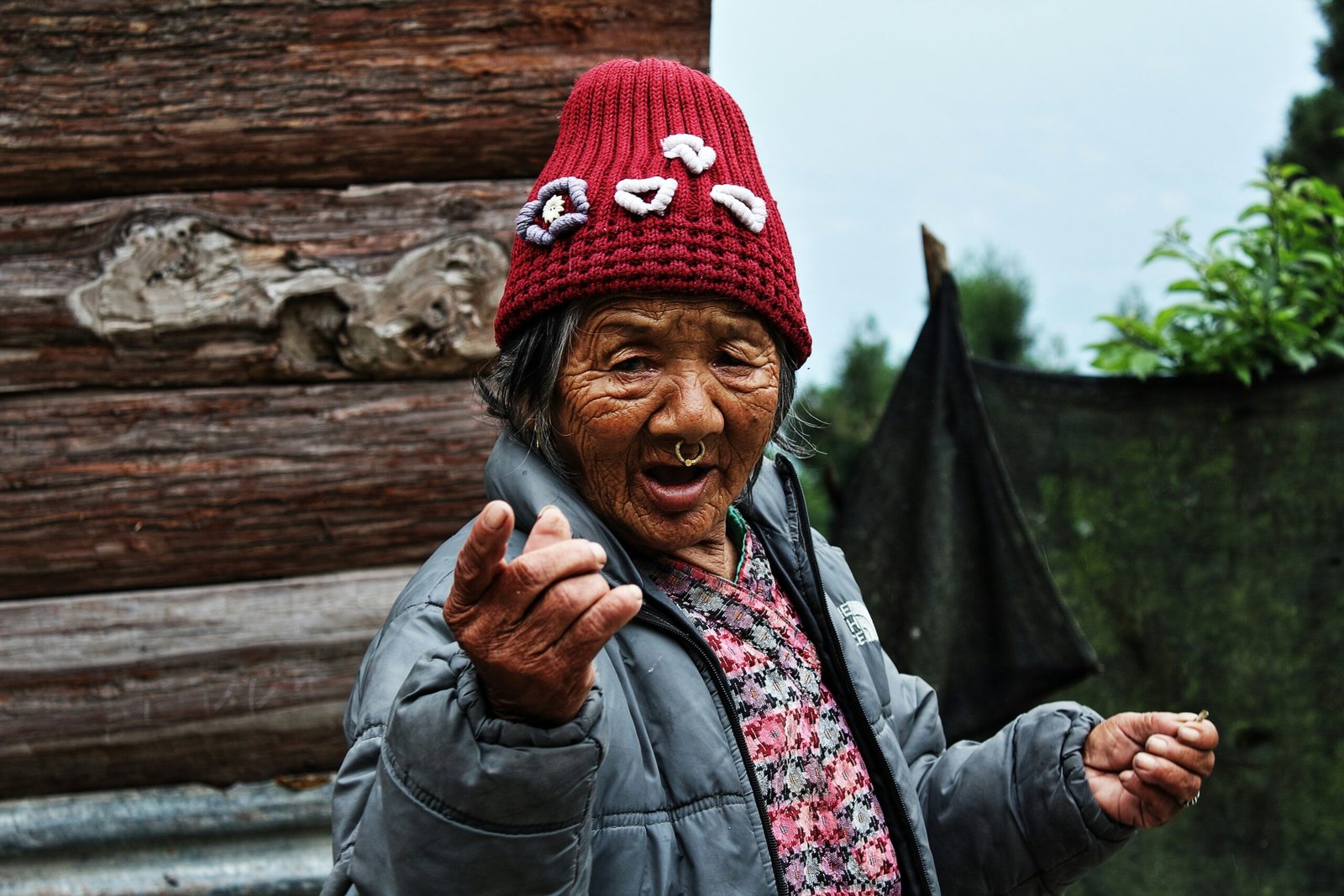
Sikkim rewards the traveller who wants more than a checklist. Here, trekking, spirituality, biodiversity, and cultural immersion are not separate experiences - they are part of the same journey.
For travellers searching for the best experiences in Sikkim, the state offers far more than postcard mountain views.
This is a Himalayan journey shaped by sacred landscapes, Indigenous culture, and extraordinary biodiversity.
From the Kanchenjunga-facing trails of Goechala to Lepcha homestays in Dzongu, from Red Panda forests in Ravangla to the high-altitude drama of North Sikkim.
Sikkim rewards those who travel for meaning, not merely movement. It is one of India’s rare destinations where adventure, spirituality, wellness, and cultural immersion exist in seamless continuity.
Why Sikkim Is Unlike Any Other Himalayan State
Sikkim occupies a narrow north-south corridor in the Eastern Himalayas.
Altitude ranges from approximately 300m at the southern border near Rangpo to 8,586m at the summit of Kanchenjunga.
Sikkim became part of India in 1975 after a referendum; before that, it was an independent Buddhist kingdom ruled by the Chogyal dynasty for three centuries.
The first Chogyal was crowned in 1642 at Yuksom, a small town in the west of the state that today is the base for treks into the Khangchendzonga massif.
In just under 100km of linear distance, the state passes through subtropical forest, temperate oak and rhododendron, alpine meadow, glaciated high terrain, and barren Tibetan-plateau-adjacent cold desert at its northern extreme.
Four Rivers that Define the Valleys
The Teesta and its tributaries (particularly the Rangeet in the west) carve the state’s primary inhabited zones.
The river originates in the Zemu Glacier (largest glacier in eastern Himalaya) north of Lachen and flows south to West Bengal;
Every major road and settlement is positioned on its slopes or those of its tributaries.
The state’s six districts organise this geography:
Mangan (formerly North Sikkim): the most dramatic district – high alpine, remotest, highest lakes, largest permit-restricted zone.
Lachung, Yumthang, Lachen, Gurudongmar, and Dzongu (Lepcha reserve) are all here.
Gangtok (formerly East Sikkim): the capital district; Tsomgo Lake, Nathu La (Indo-China border viewpoint; Indians only), Rumtek Monastery, and the Old Silk Route (Zuluk circuit) are the main draws.
Gyalshing (formerly West Sikkim): the cultural and trekking heartland – Yuksom (first capital), Pemayangtse, Tashiding, Khecheopalri Lake, Dzongri and Goechala access, Barsey Rhododendron Sanctuary, and Rabdentse ruins.
Namchi (formerly South Sikkim): lower, greener, less visited – Temi Tea Estate, Ravangla Buddha Park, Maenam Wildlife Sanctuary, Char Dham replica complex at Namchi, and the Phurchachu hot springs.
Pakyong (new; formerly East): Pakyong Airport, Aritar Lake, Rorathang; less developed for tourism.
Soreng (new; formerly West): Barsey Rhododendron Sanctuary’s southern access; Jorethang entry point.
Sikkim at a glance
| Districts | 6 (Mangan, Gangtok, Gyalshing, Namchi, Pakyong, Soreng) |
| Area | 7,096 sq km |
| Capital | Gangtok |
| Altitude range | ~300m to 8,586m (Kanchenjunga) |
| UNESCO World Heritage | Khangchendzonga National Park (2016; India’s first Mixed Heritage site) |
| Distinctions | India’s first fully organic state (2016); smallest state by population; first state to ban plastic bags (1998) |
| Known for | Kanchenjunga treks (Dzongri, Goechala), Lepcha culture (Dzongu), rhododendron and orchid diversity, Buddhist monasteries, North Sikkim permits circuit, Temi tea |
The Off-beat Places in Sikkim for Meaningful Experiences
Five places selected for GDT MVP experience density, beyond the Gangtok-Nathu La mass-market circuit.
Yuksom and the Dzongri-Goechala zone (Gyalshing district; 1,780m–4,940m) is where Sikkim’s history and its most significant trekking converge.
Yuksom was the first capital of Sikkim, founded in 1642 when three lamas crowned Phuntsog Namgyal as the first Chogyal at Norbugang, the consecration throne still stands in the forest.
Today the town is the departure point for the Dzongri trek (TFS3; 5–6 days; 4,020m).
The views of Kanchenjunga south face) and the Goechala extension (TFS4; 8–10 days; 4,940m), possibly the finest frontal view of Kanchenjunga available to trekkers in India.
Experiences: Trekking (TFS3–TFS4), Camping, Wildlife (Red Panda, Snow Leopard in upper zones), cultural living (Yuksom village homestays), Spiritual (first capital coronation site), Heritage.
Tashiding and Khecheopalri (Gyalshing district; 1,600–1,950m) hold the two most sacred sites in West Sikkim within a half-day’s walk of each other.
Tashiding Monastery – positioned on a wedge of land at the confluence of the Rangeet and Rangche rivers, is considered by tradition to hold more merit per visit than any other monastery in Sikkim.
The Bumchu ceremony (Jan–Feb) – a sealed vessel of sacred water opened once a year;
The water level read as an omen for the coming year is one of the most important ritual events in Sikkim and is conducted almost entirely in the presence of the local community.
Khecheopalri Lake (the “Wish-fulfilling Lake”); leaves said to never accumulate on the surface because birds remove them before they land;
Sacred to both Lepcha and Buddhist tradition, is 32km distant in dense oak and rhododendron forest.
Experiences: Spiritual, Buddhist cultural immersion, Nature & Mountain stays, Hiking, Sacred Ecology, Camping.
Dzongu (Mangan district; North Sikkim; 900–4,500m) is Sikkim’s most carefully protected human landscape;
A reserved territory for the Lepcha people, classified by the state as a Most Vulnerable Tribal Group and the original indigenous inhabitants of Sikkim.
Entry requires a permit from the District Collector, Mangan. Within Dzongu, the Lepcha community maintains the most intact version of their language, agricultural practice, and cosmological traditio;
Including the Tendong Lho Rum Faat festival (Aug); a community commemoration of a legendary flood; offerings on Tendong Hill; with with no tourist framework.
The landscape is extraordinary: dense subtropical forest dropping to the Teesta gorge, with hot springs (Phurchachu Tatopani), sacred caves, and views north toward the Zemu Glacier zone.
Experiences: Cultural living (Lepcha homestays; permit required), Volunteer tourism (community-based conservation), Indigenous festival encounter, Nature & Mountain stays, hot springs, spiritual.
Yumthang Valley and North Sikkim circuit (Mangan district; 3,500–4,428m) is Sikkim’s signature high-altitude landscape.
The road from Lachung up the Teesta to Yumthang (3,564m) runs through rhododendron forest that erupts in red, purple, pink, and yellow in March–April, in densities found almost nowhere else on Earth.
The Barsey and Singhalila-Kanchenjunga corridor holds approximately 600 of the world’s ~1,000 known rhododendron varieties; the Yumthang valley itself has 24 species blooming in sequence.
Zero Point at 4,428m – the end of the road, above Yumthang faces the China border with permanent snow cover and is one of the few frontier viewpoints in Sikkim’s north accessible to civilian visitors.
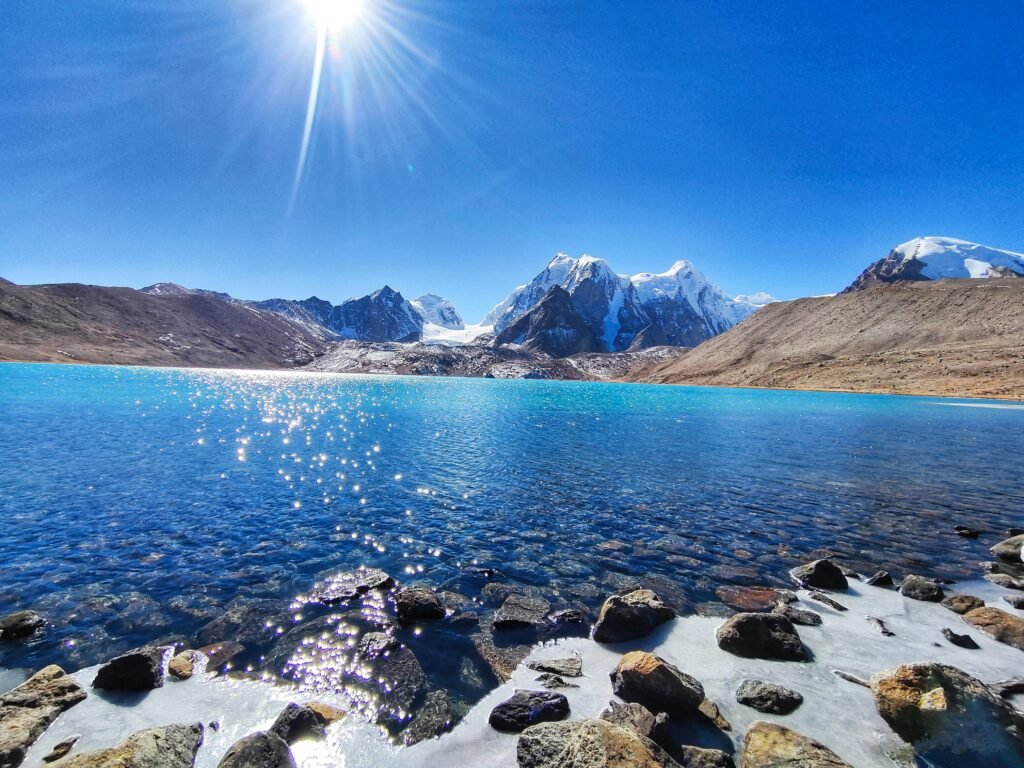
Gurudongmar Lake (5,150m; one of the highest lakes in the world; considered sacred by both Buddhists and Hindus) is an additional 2–3 hours north of Lachen. Permits Indian nationals only; foreigners strictly prohibited.
[verify current civilian access rules for Gurudongmar before planning]
Experiences: Overland self-drive (permit-required North Sikkim circuit), Motorcycle expedition,
Nature/mountain stays (Lachung, Lachen village lodges), Astro-photography, Spiritual (Gurudongmar Lake – Indians only), Wildflower photography (Mar–Apr peak).
Ravangla-Temi-Maenam zone (Namchi district; South Sikkim; 1,500–3,200m) is the least-trekked and most tea-saturated zone in the state.
The Temi Tea Estate, Sikkim’s only tea garden, established 1969, multiple international quality awards, sits on a hillside above Ravangla with Kanchenjunga visible from the garden floor on clear days.
The Maenam Wildlife Sanctuary (345 sq km; 1,829–3,235m) above Ravangla is the most accessible Red Panda habitat in Sikkim, the 10km trail from Ravangla to the Maenam summit passes through rhododendron and bamboo forest where Red Panda sightings, while not guaranteed, are more likely than in most parts of the state.
Ravangla’s Buddha Park, a 130ft seated Buddha statue in a landscaped garden, draws religious visitors.
Phurchachu hot springs near Borong (~50°C sulphur springs; ~2,100m; 1-hour drive from Ravangla) are the most accessible hot springs in southern Sikkim.
Experiences: Nature & Mountain stays (Ravangla lodges; Kanchenjunga views), Red Panda wildlife walking, tea estate cultural living, craft and artisan (Sikkim handloom), hot springs wellness.
Adventure, Culture, Wellness, Nature and Wildlife Experiences in Sikkim
Adventure Experiences in Sikkim
Trekking in Sikkim
Sikkim’s trekking is anchored in the Khangchendzonga massif.
All routes inside the national park require permits.
The Dzongri-Goechala circuit (TFS3–TFS4; base at Yuksom) is the flagship route – 8–10 days for the full Goechala extension, with the Kanchenjunga south face filling the horizon at the viewpoint.
The Singhalila Ridge route from the West Bengal-Sikkim border (Uttarey to Dzongri) is a quieter alternative.
The Barsey Rhododendron Sanctuary traverse (TFS2; 2–3 days; March–April rhododendron window);
and the Green Lake trek (expedition-grade; north face of Kanchenjunga; TFS4+; very limited permits; Ministry of Home Affairs approval required in Delhi) are the other principal routes.
GDT’s full trekking range for Sikkim is covered in the Trekking Experience Journals and the TFS1–2 Sikkim sub-child journal (already published).
Motorcycle Touring and Overland Self-drive
The North Sikkim circuit — Gangtok → Chungthang → Lachung → Yumthang → Zero Point → Lachen → Gurudongmar (Indians only), is a 3–4 day permit-required overland route through some of the most dramatic high-altitude road scenery in the Eastern Himalaya.
Self-driven motorcycles are permitted in restricted zones with special permits; self-driven cars are not permitted in most protected zones (registered operator vehicles only).
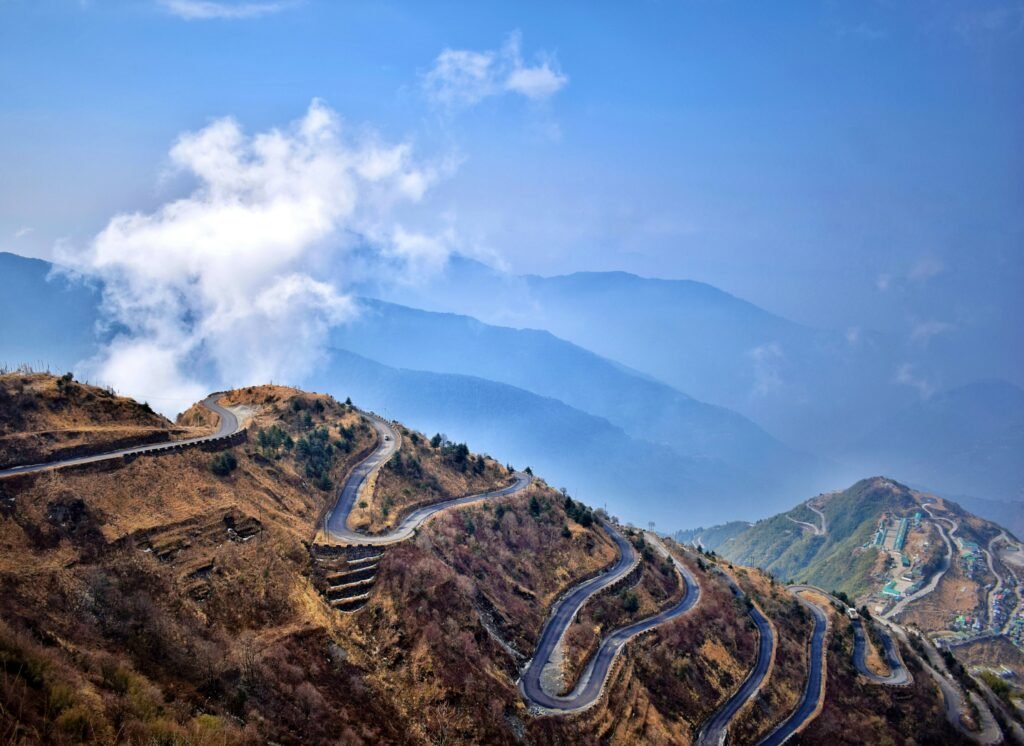
The Old Silk Route circuit in East Sikkim (Rongli → Zuluk → Kupup → Nathu La; permit required; foreigners not permitted) is the alternative overland circuit, tracing part of the historic trade route between Tibet and India.
Rock Climbing and Mountaineering
The peaks surrounding Yuksom and the Dzongri zone including Frey Peak, Mt. Jopuno, and Mt. Tenchenkang, are expedition-grade technical objectives requiring clearance from the Ministry of Home Affairs, state tourism permits, and experienced high-altitude teams.
These are not accessible day-climbing destinations; they are multi-week expeditions for qualified mountaineers.
Mountain Biking
The Ravangla to Namchi descent and the West Sikkim roads through Soreng district offer accessible downhill riding through tea gardens and subtropical forest.
No formal bike-touring infrastructure exists; this is independent or self-organised.
River Rafting
The Teesta River from Singtam to Rangpo runs seasonal Class III–IV white-water from October to April (river too high and swift in monsoon).
Rafting operations are concentrated near Melli and Rangpo, 1–2 hour drives from Gangtok. Day rafting trips are the standard offering.
Wildlife & Nature Experiences in Sikkim
Red Panda – the state animal and the encounter worth planning for
The Red Panda (Ailurus fulgens) is Sikkim’s most sought-after wildlife encounter.
Globally Vulnerable, found in the temperate bamboo and rhododendron forests between approximately 2,200–4,500m.
The Khangchendzonga NP and its buffer zones (Singhalila-Kanchenjunga corridor, Barsey Sanctuary, Maenam Sanctuary) hold the highest confirmed Red Panda density in India.
The species is shy, arboreal, and most active at dawn and dusk; dedicated wildlife tracking with a local naturalist guide in Barsey or Maenam is the most reliable approach.
November–April (outside monsoon) is the best window.
Kanchenjunga as Sacred Mountain and Biodiversity corridor
The Khangchendzonga National Park spans an extraordinary 7km of vertical altitude, from subtropical forest at 1,220m to the glaciated summit zone at 8,550m — within 1,784 sq km.
The park contains 20 peaks above 6,000m and the 26km Zemu Glacier.
It holds Snow Leopard, Himalayan Black Bear, Clouded Leopard, Musk Deer, Himalayan Tahr, and Tibetan Wolf in the upper zones.
The lower forest holds the Red Panda, Himalayan Serow, and a rich bird community.
The park’s mixed cultural-natural heritage status reflects that the mountain and its associated lakes, caves, and rivers have been sacred landscapes for Lepcha and Tibetan Buddhist communities for centuries, a co-management framework rare in Indian protected areas.
Orchids – 600+ species, state flower included
Sikkim holds over 600 orchid species, one of the highest concentrations in the world.
The state flower is the Dendrobium nobile (Noble Orchid).
The orchid diversity peaks in subtropical and temperate elevations (1,000–2,500m);
the forests around Ravangla, the Dzongu valley, and the approaches to Yuksom carry the most accessible populations. Spring (Mar–May) is the peak season.
Rhododendron Forests
36 species of rhododendron are found in Sikkim, with the Barsey Rhododendron Sanctuary (West Sikkim; Soreng district) and the Yumthang Valley holding the most spectacular concentrations.
The March–April bloom seaso, particularly in the Barsey forest and along the Yumthang road is one of the most distinctive seasonal wildflower events in the Indian Himalaya.
| Zone | Signature wildlife / nature | Best season |
|---|---|---|
| Barsey Rhododendron Sanctuary | Red Panda, 600+ rhododendron varieties, Blood Pheasant | Mar–Apr (bloom); Nov–Feb (Red Panda) |
| Maenam Wildlife Sanctuary | Red Panda, Himalayan Black Bear, Leopard | Nov–Mar |
| Khangchendzonga NP (upper) | Snow Leopard, Himalayan Tahr, Tibetan Wolf, Musk Deer | May–Jun; Oct–Nov |
| Yumthang Valley | Rhododendron bloom; alpine wildflowers | Mar–Apr (bloom); Jun–Sep (green) |
Wellness Experiences in Sikkim
Hot Springs circuit
Sikkim’s hot springs are embedded in its landscape at multiple altitude levels – from subtropical gorge to high alpine.
Yumthang hot springs (3,564m; inside the rhododendron valley) are accessible only via the North Sikkim permit circuit;
the springs here are low-temperature and modest in size but the setting – in a river valley ringed by rhododendron forest and high peaks is exceptional.
Phurchachu/Borong hot springs (~2,100m; near Ravangla in South Sikkim; ~50°C; sulphur; 1-hour drive from Ravangla) are the most accessible and have basic bathing facilities.
Ralang hot springs (near Ralang Monastery, South Sikkim) combine bathing access with a monastery visit.
Yumey Samdong (at 4,300m between Lachen and Gurudongmar) has hot springs at extreme altitude, one of the world’s highest-altitude geothermal sites.
Traditional Healing and Retreat
Sikkim’s Lepcha community maintains an indigenous healing tradition based on medicinal plants of the forest, carried by practitioners called Bongthing. Lepcha traditional healers who work at the intersection of animist and Buddhist practice.
This tradition is most intact in Dzongu; access requires both a permit and a cultural introduction through a community-based host.
Men-Tsee-Khang (Tibetan medicine) practitioners serve both Buddhist communities in Gangtok; several Buddhist monasteries particularly Rumtek and Enchey offer extended residential stays for serious meditation practitioners on an informal basis during the non-festival season.
Temi Tea Estate: Organic tea tasting and estate walks at Temi, Sikkim’s only tea garden are a sensory rather than physiological wellness experience;
but the combination of the estate’s terraced garden, Kanchenjunga views, and a cup of hand-crafted Sikkim Orthodox tea is the most distinctive slow-travel encounter in South Sikkim.
Temi teas have received multiple international quality certifications and are among the most awarded small-estate teas in India.
Cultural Experiences in Sikkim
The Monarchy and the Monasteries
Sikkim was ruled as a Buddhist theocracy by the Chogyal (“divine ruler”) from 1642 until the 1975 merger with India. This 333-year monarchy left behind a network of monasteries, royal residences, and sacred sites that constitute one of the most intact Buddhist royal landscapes in the Indian Himalaya.
Yuksom’s Norbugang the coronation throne made of stone is one of the only surviving physical sites of a Buddhist coronation ceremony in India.
Pemayangtse Monastery (Gyalshing district; Nyingmapa order; one of the oldest intact monasteries in the state) contains the “Sangchhen Dorji Lhuendrup”;
a seven-tiered wooden model of the celestial palace of Guru Rinpoche, painted and crafted over years by a single monk, housed in the upper assembly hall.
Rumtek Monastery (24km from Gangtok; Kagyu lineage; one of the most significant Tibetan Buddhist monasteries outside Tibet) is the seat of the Karmapa in exile;
its ritual calendar and the black-hat ceremony are among the most attended religious events in East Sikkim.
The Three Communities of Sikkim
The Lepcha (Rong people; original inhabitants; Mayel Lyang “hidden paradise” is their name for Sikkim);
the Bhutia (Tibetan-origin Buddhist community whose ancestors came from Kham; keepers of the monastery tradition);
and the Nepali (the largest community by population; Hindu and Christian in tradition; majority since the 19th century) coexist in a density unusual in the Indian Himalaya.
The Lepcha language, cosmology, and indigenous knowledge system are in a critical preservation phase; Dzongu is the most intact living repository.
The Bhutia dzongkha tradition of thangka painting, butter sculpture, and the art of Cham masked dance is maintained primarily in the monastery community.
Nepali textile traditions – the Dhaka woven pattern (specific to Sikkim; geometric, colourful, used in traditional clothing and bags) and the distinctive handloom production of Ravangla district, represent the craft tradition of the majority community.
Pang Lhabsol – the festival of no tourist equivalent
The Pang Lhabsol festival (Aug–Sept; dates follow the Tibetan lunar calendar) is unique to Sikkim.
It is the ritual propitiation of Kanchenjunga as the protector deity of the state, manifested in the Warrior Dance (Chaam) performed by monks.
The dance depicts the divine war against evil forces, with elaborate armour, flags, and mask costumes specific to this ceremony and not used in any other Buddhist festival in India.
Unlike Hemis or Tsechu festivals in Ladakh and Darjeeling, Pang Lhabsol is not primarily a tourist occasion – it is a state-level civic ceremony of Sikkimese cultural identity.
Attending requires being in Gangtok or West Sikkim at the right time in August–September and knowing which monasteries are conducting the Cham.
Bumchu at Tashiding – the festival of the sealed vessel
The Bumchu ceremony at Tashiding Monastery (Jan–Feb; exact date per lunar calendar) is possibly the most important single ritual event in Sikkim’s religious calendar.
A sealed vessel of sacred water kept in the monastery all year is opened once annually;
the level, colour, and character of the water inside are read by the head lama as an omen for the coming year.
The ceremony is conducted in the presence of the monastic community and the local population; outside visitors attend but no tourist infrastructure surrounds it.
There is no stage, no souvenir stall, no tour group. The ceremony simply happens, as it has for centuries.
Cardamom and the Organic agriculture Heritage
Sikkim is India’s largest producer of large cardamom, and cardamom cultivation is visible across the forested mid-altitudes (1,500–2,000m) of Gyalshing, Mangan, and Namchi districts.
The state achieved fully organic status in 2016 after banning chemical fertilisers and pesticides across all agriculture from 2003.
Visiting a cardamom farm – most are small family plots in forest shade, and understanding the organic certification story is one of the most accessible cultural living encounters in West and North Sikkim.
Cuisine Thukpa, Gundruk, and the Organic Kitchen
Sikkimese cuisine reflects the state’s ethnic layering.
Thukpa (Tibetan noodle soup; hand-pulled noodles with vegetables and meat; the Buddhist community’s daily staple from Gangtok north) is the baseline.
Gundruk (fermented and dried leafy greens; pressed and dried; then reconstituted in soup or used as a flavouring; a preserved vegetable of Nepali Himalayan origin; one of India’s most distinctive fermented foods) is the Nepali community’s contribution to the table consumed across the state.
Sel roti (a deep-fried ring bread made from fermented rice batter; prepared at home for festivals, not in restaurants; the smell of sel roti frying is the smell of Nepali festivals in Sikkim) is the ceremonial food that marks the occasion before it marks the mouth.
Momo is everywhere but in Sikkim the filling often includes nettles or pork rather than the chicken-only version that has spread across India.
Chhang (millet beer; traditional across Lepcha, Bhutia, and Nepali communities; served in a bamboo vessel topped up with hot water through a bamboo straw; warm and mild) is the most distinctively Sikkimese alcoholic tradition.
How to Plan a Sikkim Trip Around Your Travel Style
The Sikkim Permit System
Every visitor to Sikkim requires an Inner Line Permit (ILP) at entry obtainable at the Rangpo (road, from West Bengal) or Melli (road, from Nepal) checkposts, or at the Sikkim Tourism Office in Gangtok.
The ILP is straightforward for Indian nationals; foreigners require additional permits and must work through registered operators for most visits beyond Gangtok.
| Zone | Who needs permit | Permit type | Through |
|---|---|---|---|
| North Sikkim (Lachung, Yumthang, Lachen, Gurudongmar) | All visitors | PAP (Protected Area Permit) | Registered tour operator; issued in Gangtok |
| East Sikkim (Tsomgo Lake, Nathu La) | All visitors | PAP | Registered operator or Tourism office, Gangtok |
| East Sikkim (Zuluk/Old Silk Route) | Indians only | PAP | Rongli SDPO office |
| Dzongri / Goechala trek (KNP) | All; foreigners need additional RAP | Trek permit + PAP | Registered trekking operator; Yuksom SDM |
| Dzongu (Lepcha reserve) | All | Special permit | DC office, Mangan |
| Nathu La, Gurudongmar, Zuluk | Indians only | PAP | Foreigners STRICTLY PROHIBITED |
Children under 5 are not permitted to high-altitude zones (Gurudongmar, Yumthang, Nathu La).
Carry multiple copies of all permits and ID.
Apply at least 24–48 hours in advance for North Sikkim circuits; operators typically organise these the evening before.
[verify latest permit rules before planning as regulations change frequently]
When to Visit Sikkim for Trekking, Festivals, and Wilderness
| Zone | Best window | Secondary | Avoid |
|---|---|---|---|
| Gangtok and East Sikkim | Oct–Nov; Mar–May | Dec–Feb (clear but cold) | Jun–Sep (heavy monsoon) |
| West Sikkim (Yuksom, Pelling, Ravangla) | Oct–Nov; Mar–May | Dec–Feb | Jun–Sep (landslide risk) |
| Dzongri-Goechala trekking | May–Jun; Oct–Nov | — | Jul–Sep (monsoon; trails slippery) |
| North Sikkim (Yumthang, Lachung) | Mar–May (rhododendron); Jun–Sep (green season) | Oct–Nov | Dec–Feb (roads may close) |
| Gurudongmar Lake | May–Jun; Oct (brief) | — | Nov–Apr (road often closed) |
| Barsey Rhododendron Sanctuary | Mar–Apr (peak bloom) | Oct–Nov (Red Panda) | Monsoon |
| Red Panda (Barsey, Maenam) | Nov–Mar | Apr (post-bloom clear) | Monsoon |
| River rafting (Teesta) | Oct–Apr | — | May–Sep (monsoon; water too high) |
Monsoon note:
Sikkim receives some of the heaviest monsoon rainfall in India (June–September).
Landslides routinely close roads including the only road to Yuksom and the North Sikkim circuit.
Trips in this window require extreme flexibility; the rewarding exception is the Yumthang Valley, which is lush and dramatic in the rain.
Getting to Sikkim
| Mode | From | Route | Approx time |
|---|---|---|---|
| Air — Pakyong (PYG) | Kolkata; Delhi (connecting) | Small airport; limited flights; nearest to Gangtok | 1 hr flight from Kolkata; 1.5 hrs road to Gangtok |
| Air — Bagdogra (IXB) | Delhi, Kolkata, Mumbai | Most reliable airport for Sikkim; direct to NJP/Siliguri | 1.5–2 hrs flight; then 3.5–4.5 hrs road to Gangtok |
| Rail — NJP (New Jalpaiguri) | Delhi, Kolkata, Mumbai | Nearest practical railhead; shared taxis and jeeps to Gangtok | Delhi: 20 hrs train; NJP to Gangtok: 3.5–4.5 hrs road |
| Road from Siliguri / NJP | — | NH 10; via Rangpo (ILP checkpoint); 114km | 3.5–5 hrs depending on traffic |
| Road from Darjeeling | — | Via Jorethang or Rangpo; 95–110km | 4–5 hrs; shared jeeps available |
Entry note:
All visitors collect their ILP at the Rangpo or Melli checkpost on entry by road.
By air via Pakyong, permits can be arranged in advance through the Sikkim Tourism office. Have ID and passport photos ready at entry.
Getting Around Within Sikkim
Shared jeeps (sumo taxis) are the primary mode of transport between towns in Sikkim;
Fixed routes, affordable, departing when full, and running through most of the day from early morning.
Private hire is standard for North Sikkim circuits (mandatory through registered operators for permit zones) and for Dzongri trek logistics.
Self-drive cars are not permitted in most protected zones; motorcycles with special permits are.
Gangtok is the hub for all North and East Sikkim circuits; Gyalshing (Geyzing) town is the hub for West Sikkim and Yuksom access.
No railway exists within Sikkim.
Frequently Asked Questions before Planning Sikkim
Do I need a permit just to enter Sikkim?
Yes.
An Inner Line Permit (ILP) is required for all visitors. Indian and foreign to enter Sikkim.
It is issued at the Rangpo or Melli checkposts on entry by road, or can be arranged in advance.
The ILP is straightforward and free for Indian nationals; foreigners require additional permits for most destinations beyond Gangtok and need to travel through a registered operator
Can foreigners visit Gurudongmar Lake and Nathu La?
No.
Gurudongmar Lake and Nathu La Pass are prohibited to foreign nationals due to border security regulations.
Only Indian citizens with a Protected Area Permit (PAP) can visit these zones.
Yumthang Valley, Tsomgo Lake, and the Dzongri trek are accessible to foreigners with the correct permits through a registered operator.
What is the best trek in Sikkim and when should I do it?
The Dzongri-Goechala circuit (TFS3–TFS4; 8–10 days; base at Yuksom) offers the closest and most dramatic views of Kanchenjunga’s south face available to trekkers anywhere in India.
The ideal windows are May–Jun and Oct–Nov.
All trekkers need a park permit through a registered operator; foreigners additionally need a Restricted Area Permit.
When is the rhododendron bloom in Sikkim and where is it best?
March–April is the peak window.
The Barsey Rhododendron Sanctuary (West Sikkim; Soreng district) and the Yumthang Valley (North Sikkim; permit required) are the primary sites.
The Yumthang valley has 24 rhododendron species blooming in sequence; Barsey holds approximately 600 of the world’s ~1,000 known rhododendron varieties.
Both require advance planning, Yumthang especially, given the North Sikkim permit lead time.
Is Sikkim really fully organic and what does that mean practically?
Yes, Sikkim became India’s first fully organic state in 2016 after a 13-year transition that banned chemical fertilisers, pesticides, and synthetic inputs across all registered agricultural land.
In practice, it means cardamom, ginger, oranges, vegetables, and tea grown in Sikkim are certified organic without requiring individual farm verification.
The Temi Tea Estate, cardamom farms in Gyalshing, and the village markets in Yuksom and Ravangla all reflect this; you are unlikely to find chemically-treated produce in Sikkim’s local markets.
What is Sikkim’s connection to Kanchenjunga, is it just a view or something more?
Much more. Kanchenjunga is the most sacred natural feature in Sikkimese culture worshipped as the protector deity of the state by the Buddhist (Bhutia) community, and called Mayel Lyang (“hidden paradise”) by the Lepcha.
The annual Pang Lhabsol festival (Aug–Sep) is the civic ceremony of that worship; masked dances performed at monasteries across the state to honour and propitiate the mountain.
The UNESCO Mixed Heritage inscription of Khangchendzonga National Park in 2016 specifically recognised this cultural-natural convergence, making it the first such “mixed heritage” site in India.