
Most tourism is organized around seeing places.

Cultural immersion begins when travel becomes organized around participation instead;

Sharing meals, learning skills, joining rituals, listening to stories, moving through landscapes slowly enough for understanding to accumulate rather than merely pass by.
For travellers seeking immersive cultural travel experiences, the biggest shift is moving from observation toward participation.
Traditional tourism often prioritizes landmarks, itineraries, and rapid movement between destinations.
Cultural immersion works differently.
It is organized around entering the rhythms, practices, food systems, histories, ceremonies, crafts, and daily lives that give a place its meaning.
Whether through homestays, pilgrimage, backpacking, culinary trails, artisan workshops, or environmental volunteering;
Immersive cultural travel creates understanding through presence and participation rather than passive consumption.
The experience depends not only on where you travel, but also on how attentively and ethically you choose to engage.
What Cultural Immersion Actually Means
Travel That Stays With You Does Not Happen to You. It Happens Through You.
There is a version of travel that moves across the surface of a place — the monuments, the viewpoints, places to visit in the guidebook, and leaves having seen what was arranged to be seen.
And then there is this version:
Travel that moves through the interior of a place, through the people who live there, the things they make, the ceremonies they perform, the food they have eaten for generations, the knowledge they have accumulated across time.
This version stays.
Not as photographs, but as understanding, a changed relationship with what other ways of living are possible, and therefore what your own way of living is.
Cultural Immersion experiences is GDT’s most expansive category.
It covers many distinct experiences across three modes of engagement;
from walking a pilgrimage route and living inside a farming community to learning a weaving tradition and following a food trail across a landscape.
What they share is not a subject matter but an orientation: the traveller is not observing the culture from outside it.
They are, to varying degrees and in different ways, inside it.
| Traditional Tourism | Cultural Immersion Travel |
|---|---|
| Observation-focused | Participation-focused |
| Fast itineraries | Slow engagement |
| Attraction consumption | Relationship-building |
| Fixed schedules | Discovery-led movement |
| Surface-level interaction | Deeper contextual understanding |
| Destination checklist | Meaningful lived experience |
How To Use This Hub
Three clusters organise the experiences by how you engage.
Not where you go or what you see, but what the experience asks of you and what you bring to it.
Participatory experiences ask you to be present inside something.
A pilgrimage, a festival, a community’s daily life.
The experience is defined by your presence within it, not by your observation of it from outside.
Discovery experiences ask you to follow something;
A food trail across a landscape, a civilisational thread through its monuments, a backpacking circuit through a geography at ground level.
The experience is self-directed pursuit; the understanding accumulates as you move.
Skills & Making experiences ask you to acquire and apply.
A craft learning, a survival technique, a creative practice.
You leave with something made or learned that did not exist before the experience.
Most cultural immersion travel involves all three in some proportion.
A week in Varanasi might involve walking the ghats at dawn (Participatory), following the city’s silk weaving geography through its lanes (Discovery), and sitting with a weaver for a morning of instruction (Skills & Making).
The clusters are orientation tools, not rigid boxes.
Who is Immersive Cultural Travel Experience For
Three primary archetypes drive the cultural immersion category.
The Culture Seeker
is motivated by the depth and specificity of what a place knows —
its craft traditions, its food culture, its performing arts, its historical layers.
The Culture Seeker is not looking for the highlights; they are looking for the interior.
The experience that satisfies them is the one that reveals something that most visitors do not see, not because it is hidden but because it requires patience, language, and the willingness to slow down enough to be received.
The Conscious Traveler
is motivated by the ethics of the encounter —
by the quality of the relationship between visitor and host, by the question of who benefits from the visit, and by the desire to travel in a way that gives more than it takes.
The Conscious Traveler is the primary persona for the experiences in this hub that involve the most direct contact with vulnerable or marginalised communities:
tribal and indigenous living immersion, volunteering, and agritourism.
The peer journals for these experiences are written with that ethical orientation explicitly, not as a disclaimer but as the frame.
The Meaning Seeker
arrives at cultural immersion through the question of what endures —
in a civilisation, in a tradition, in a way of living.
Pilgrimage is the most direct address to this motivation; heritage and historical tourism is another.
The Meaning Seeker is looking for encounters with what has lasted and what that persistence means.
Most cultural immersion travellers carry elements of all three.
The question is which is primary at this moment, and which experience best serves that primary motivation.
The Three Variants of Cultural Immersion
Participatory Travel Experiences
The primary mode: being inside an experience;
A community, an event, a way of life, as an active presence rather than passer by.
Pilgrimage Tourism
One of the oldest forms of travel and one of the most internally demanding.
A pilgrimage is not a heritage visit with walking involved;
it is a journey undertaken with a specific quality of intent, in which the physical act of moving through sacred geography is itself the practice.
India’s pilgrimage landscape is among the most extensive and most varied in the world:
the Char Dham circuit in Uttarakhand, the Amarnath yatra in Kashmir, the Kailash Mansarovar crossing into Tibet, the Sabrimala ascent in Kerala, the Varanasi ghats as a living pilgrimage city.
Globally, the Camino de Santiago, the Shikoku 88-temple circuit, and the Hajj define the landscape.
The peer journal covers the experience with the care it deserves — the physical preparation, the religious and cultural protocols, the question of who this experience is for, and the distinction between participating in a pilgrimage and visiting a pilgrimage site.
[Pilgrimage Tourism — peer journal [coming soon] → ]
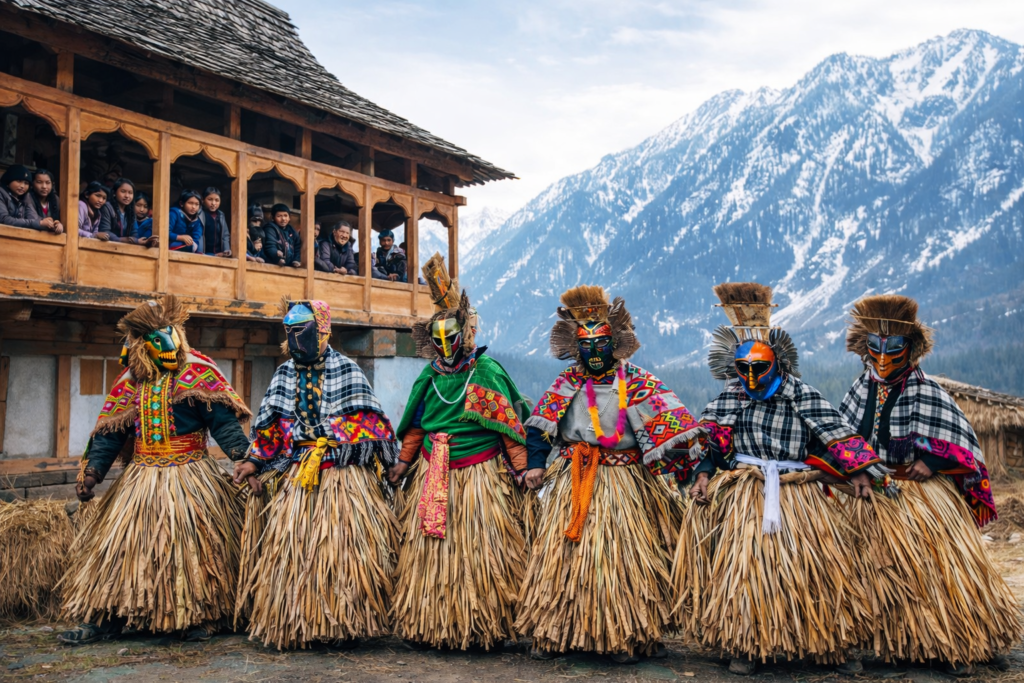
Cultural & Ritual Festivals
Covers the full spectrum of community-calendar festivals;
religious and ritual events, folk and tribal cultural festivals, and seasonal celebratory events that are defined by their connection to a place, an agricultural cycle, or a community’s own rhythm rather than by a music programme.
Religious and ritual festivals: (Kumbh Mela, Durga Puja, Thrissur Pooram, Pushkar Camel Fair, Hemis Monastery Festival),
Folk and tribal cultural festivals (Hornbill Festival in Nagaland, Chhau performance at Chaitra Parba in Purulia), and
Seasonal cultural celebrations (Rann Utsav, Jaisalmer Desert Festival, harvest festivals, Onam);
are all covered in a single peer journal under the same foundational principle: attend as a guest, not as a consumer.
The peer journal covers the specific cultural and behavioural protocols for each major festival type, the distinction between the tourist-facing version of a festival and the community experience of it, and how to position your attendance correctly.
[Cultural & Ritual Festivals — peer journal [coming soon] → ]
Music Festivals
Events that are primarily defined by their music programme;
curated performances, artist lineups, and the specific social experience of a crowd gathered around live music.
India’s music festival landscape has grown significantly in the last decade: NH7 Weekender, Magnetic Fields (Rajasthan), Ziro Music Festival (Arunachal Pradesh), Jodhpur RIFF, Kasauli Rhythm & Blues.
Internationally, the Edinburgh Festival, Glastonbury, Fès World Sacred Music Festival, and the Mali Festival in the Desert define the landscape.
The peer journal covers what makes a music festival worth building a journey around;
how to evaluate the quality and authenticity of the programme, the specific travel planning requirements that festival timing imposes, and the meaningful distinction between a festival that is rooted in a place’s musical culture and one that is a touring commercial event.
[Music Festivals — peer journal [coming soon] →]
Tribal & Indigenous Living Immersion
The most demanding and most ethically complex experience in the cultural immersion category.
Living inside a tribal or indigenous community:
in the Northeast frontier states, in the Andaman Islands, in tribal Odisha and Chhattisgarh, or internationally in communities in Southeast Asia, Africa, or the Americas —
is an experience that is only genuinely available through relationships built on consent, mutual benefit, and the community’s own agency over the encounter.
The peer journal is written with the highest level of ethical care specifically on the distinction between community-controlled cultural exchange and extractive tourism that takes without giving, specific on the role of intermediaries and how to assess whether they are community-aligned, and specific on the behavioural and cultural protocols that make an immersion encounter respectful rather than intrusive.
[ Tribal & Indigenous Living Immersion — peer journal [coming soon] → ]
Homestay / Cultural Living
Living inside a household rather than staying in accommodation adjacent to it.
The homestay is the most consistently underestimated experience in the cultural immersion category, not because it is the most dramatic but because it is the most revealing.
The quality of encounter available over three days of shared meals, shared routines, and unmanaged conversation with a host family is not replicable in any other format.
India’s homestay geography is deep: Ladakhi village stays, Coorg coffee estate homestays, Konkan coastal family houses, Sikkim or Northeast tribal community rooms.
The peer journal covers what makes a homestay a genuine cultural immersion (as distinct from a budget accommodation option with breakfast), how to find and evaluate homestay hosts, and the specific qualities of attention and behaviour that make the experience valuable for both guest and host.
[ Homestay / Cultural Living — peer journal [coming soon] → ]
Agritourism / Farm Tourism
Participating in the working life of a farm, seasonal harvesting, livestock care, crop preparation, traditional processing —
as a means of understanding where food comes from and the specific knowledge embedded in agricultural practice.
India’s agritourism geography is rich and varied:
Tea plucking in Darjeeling and Munnar, rice paddy work in Kerala’s backwater villages, saffron harvesting in Kashmir (one of the most specific and time-limited agritourism windows in India), apple orchards in Himachal Pradesh, coffee picking in Coorg and the Nilgiris.
The peer journal covers the experience type honestly, including the physical reality of agricultural work, the seasonal dependency, and how to evaluate whether an agritourism programme is genuine participation or a performance of farming for visitors.
[ Agritourism / Farm Tourism — peer journal [coming soon] → ]
Volunteer & Environmental Tourism
Travel organised around a sustained contribution, to a community, a conservation programme, a built heritage project, or an environmental restoration effort.
The peer journal covers both volunteer tourism (community-facing; teaching, building, healthcare support, skills transfer), and
Environmental volunteering (conservation-facing; wildlife monitoring, habitat restoration, marine conservation, reforestation),
[Volunteer & Environmental Tourism — peer journal [coming soon] →]
Discovery Travel Experiences
Following something across a landscape or subject —
A food geography, a civilisational thread, a backpacking circuit, where the understanding accumulates through movement and finding.
Culinary Tourism / Food Trails
Following a thread of taste, provenance, and food culture across a geography —
from the source of an ingredient to the table where it is eaten, from the regional dish to the community that gives it its meaning.
A food trail is not a restaurant tour; it is a form of cultural discovery in which food is the organising principle.
India’s food trail geography is among the richest in the world:
The Chettinad spice corridor in Tamil Nadu, the Onam sadya circuit across Kerala, the street food belt of Kolkata, the Buddhist monastery kitchen trail in Ladakh and Spiti, the coastal seafood circuit from Mangaluru to Goa.
[Culinary Tourism / Food Trails — peer journal [coming soon] →]
Heritage & Historical Tourism
Tracing an architectural, historical, or civilisational thread through its physical remains —
The temples, the fortifications, the palaces, the industrial monuments, the battle sites, the cities built by specific decisions of specific people at specific moments.
India’s heritage geography is one of the most layered in the world:
Four UNESCO World Heritage Sites per major state on average;
Living cities like Varanasi and Madurai where the historical thread runs unbroken from antiquity to the present day;
Mughal, Rajput, Chola, Vijayanagara, and colonial architectural traditions distributed across a subcontinent.
[→ Heritage & Historical Tourism — peer journal [coming soon] → ]
Backpacking
Travel at ground level with minimal infrastructure —
Moving between places by local transport, staying in budget accommodation, eating where locals eat, allowing the itinerary to respond to what is discovered rather than executing a fixed plan.
Backpacking is the most self-directed form of discovery travel and the format that most consistently produces the kind of unplanned encounters;
The conversation in a bus station, the festival stumbled upon, the host who becomes a guide, leave the deepest traces.
India’s backpacking circuits are among the most established in the world: the Hampi-to-Goa circuit, the Himalayan town-to-town trail, the Northeast frontier circuit, the Rajasthan desert loop.
[Backpacking — peer journal [coming soon] →]
Skills & Craft Travel Experiences
Acquiring a competency and applying it, producing something that did not exist before the experience.
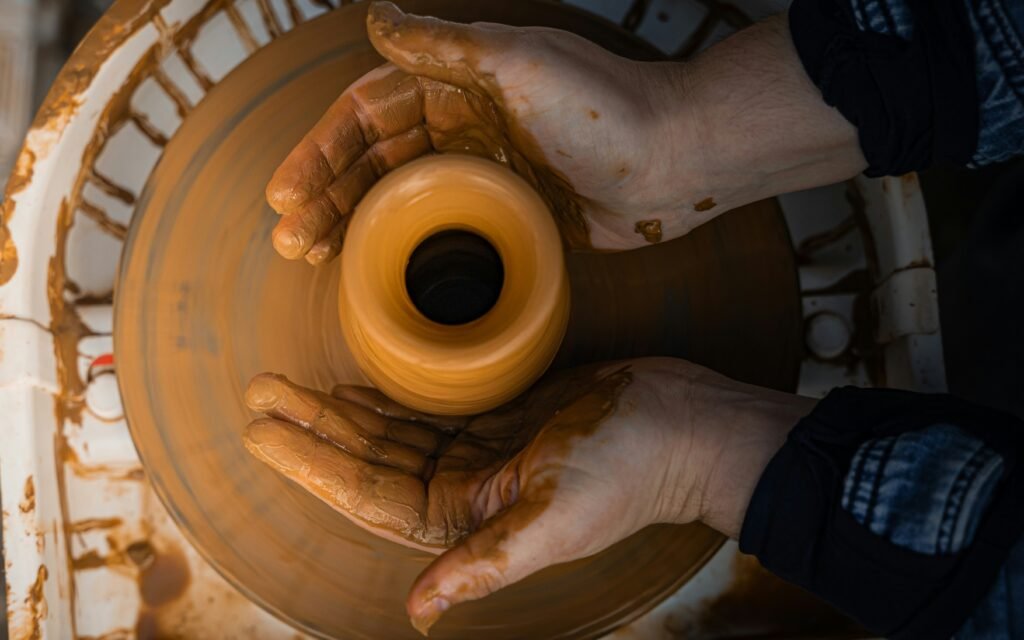
Craft & Artisan
Learning and practising traditional craft in the place and with the practitioner that gives it its meaning.
The peer journal covers the full spectrum of artisan experiences available in India and internationally:
Pottery and ceramics (the terracotta tradition of Bishnupur,
blue pottery of Jaipur, the red clay work of Rajasthan villages),
textile and weaving (Kanjivaram silk weaving in Kanchipuram,
pashmina processing in Kashmir,
natural dye block printing in Bagru and Sanganer), and
metal craft, woodwork, and lacquerware (brasswork in Moradabad, dhokra lost-wax casting in Bastar, lacquer turnery in Etikoppaka, wood carving in Saharanpur).
[ Craft & Artisan — peer journal [coming soon] → ]
Creative Workshops & Residencies
Immersive creative programmes, typically between three days and several weeks;
In which a specific creative practice (writing, painting, printmaking, ceramics, textile art, documentary photography, design thinking, creators meet) is the primary subject, delivered in a residential setting by a practising coach, artist or craftsperson.
The residency format in particular in which the participant lives and works in the creative environment for an extended period, produces a quality of creative development that weekend workshops and online courses cannot replicate.
[Creative Workshops & Residencies — peer journal [coming soon] → ]
Survival Skills
The acquisition of practical competencies for operating safely and self-sufficiently in natural environments —
fire-making, shelter construction, navigation without instruments, foraging, water sourcing and purification, tracking, and emergency protocols.
The experience sits at the intersection of the cultural immersion and adventure categories:
Many survival skills are drawn from indigenous and traditional knowledge systems:
The fire-making techniques of the Bishnoi,
The navigation practices of the Himalayan pastoral communities,
The tracking knowledge of forest-dwelling tribes); and,
learning them in context from practitioners who use them as living skills rather than demonstrating them as performances, is a form of cultural encounter as much as a physical skill acquisition.
[ Survival & Wilderness Skills — peer journal [coming soon] → ]
Photography as Attention, Not Extraction — a Cross-Cutting Thread
Photography is not a standalone experience.
It is a mode of attention that runs through every cluster, and the quality of that attention is what determines whether photography enhances a cultural immersion experience or diminishes it.
Cultural photography, street photography, festival photography, craft documentation, agricultural photography — these all derive their meaning from the primary experience they are attached to.
A photograph of a weaver at work is made possible by the craft immersion experience that brought the photographer to that weaver’s workshop.
A photograph of a festival procession is made possible by the participatory presence that earned the proximity.
If you are travelling specifically for photography, building an itinerary around photographic opportunity rather than the other way around.

A Note on Ethics
Cultural immersion is the category in which the ethics of travel are most directly at stake.
In adventure travel, the primary ethical questions are about safety and environmental responsibility.
In wellness travel, they are about personal health and operator quality.
In cultural immersion, the ethical questions are about relationships, between the visitor and the community being visited, between the traveller’s desire for experience and the community’s right to dignity and agency.
The single most useful principle across all cultural immersion experiences:
The community you are visiting is not the experience.
They are the people whose lives constitute the context for an experience.
The quality of the encounter depends more on the quality of your attention and your respect for that distinction than on the quality of your itinerary.
Frequently Asked Questions
What is cultural immersion travel?
Cultural immersion travel is a form of travel organized around participation rather than observation. It involves engaging meaningfully with local communities, traditions, food systems, crafts, rituals, histories, and everyday life rather than only visiting attractions.
How is cultural immersion different from tourism?
Traditional tourism is often organized around sightseeing and consumption, while cultural immersion focuses on participation, slower engagement, relationship-building, and understanding how people actually live within a place or community.
What are examples of cultural immersion experiences?
Examples include homestays, pilgrimage journeys, food trails, backpacking, artisan workshops, agritourism, environmental volunteering, festival participation, and learning traditional skills directly from local practitioners.
Why is slow travel important for cultural immersion?
Slow travel creates the time necessary for observation, participation, conversations, trust-building, and unplanned discovery. Cultural understanding rarely develops through rushed itineraries or rapid destination hopping.
What makes a cultural immersion experience authentic?
Authentic cultural immersion experiences involve genuine participation, respectful engagement, community agency, ethical operator practices, and environments where local life is not staged solely for tourists.
Are homestays considered cultural immersion?
Yes. Homestays are one of the most accessible forms of cultural immersion because they allow travellers to temporarily participate in the rhythms, meals, customs, and daily life of a household or community.
Is photography appropriate during cultural immersion travel?
Photography can enhance cultural immersion when practiced respectfully and ethically. Consent, sensitivity, context, and awareness of community boundaries are especially important in religious, tribal, and ceremonial settings.
What is the biggest ethical principle in cultural immersion travel?
The most important principle is understanding that communities are not tourist attractions. Travellers are guests within someone else’s lived reality, and respectful attention matters more than collecting experiences.