
Find the best adventure travel experiences for you. Explore the world's best land, air, water, and snow experiences with expert insights on preparation, skill, and safety.
What Is Adventure Travel?
Most travel is receptive. You arrive at a place, you observe it, you move through it, you leave. Adventure travel inverts this.
The place is not the point – or not only the point.
The experience is defined by what the body does, what the terrain demands, and what the gap between those two things produces.
A river does not give you a white-water experience; you take it through one.
A mountain does not give you a summit; you climb to it.
The ocean does not give you a wave; you read it, paddle for it, and either catch it or don’t.
This is not a minor distinction. It determines everything about how adventure travel is planned, assessed, and honestly described.
The question is never just “where?”
It is always simultaneously “what am I capable of, what will this demand of me, and what does the gap between those two things require in preparation?”
GDT’s Field Notes adventure journal covers few distinct experiences across four environments:
Land and Altitude, Air, Water and Snow and Ice.
Each has its own peer journal covering the full depth:
what the experience involves, who it is for, what the physical demands are, what the risks are and how they are managed, how to prepare, and where in the world the experience is practised.
This hub is the map. The peer journals are the territory.
How to Choose the Right Adventure Experiences?
The four clusters below organise the best experiences by environment.
Start with the cluster that reflects where you want to operate – the mountain, the sky, the water or the snow;
and then find the experience within it that matches your current capability, your appetite for risk, and the kind of physical challenge you are looking for.
If you are not sure where to start, the most useful question to ask is this: what does the experience ask of you?
Some adventure experiences are primarily physical, sustained effort across days or hours, cardiovascular demand, strength and endurance.
Others are primarily technical, a specific skill that must be acquired or developed to participate safely.
Others still are primarily psychological, the management of exposure, height, speed, or the specific quality of irreversibility that some adventure experiences carry.
The peer journals are honest about which category each experience falls into, and what that means practically for preparation, for the first-timer, and for the experienced participant who wants to go further.
Adventure Travel Personas: Which One Are You?
Two primary archetypes drive the adventure category. Understanding which one describes your current motivation helps orient the choice.
The Physical Challenger is motivated by what the body can do;
The satisfaction is in the sustained effort – the accumulation of kilometres at altitude, the progression from a basic skill to a competent one, the completion of something that required genuine preparation.
The Physical Challenger does not necessarily seek danger; they seek demand.
The river rapid is interesting not because it is dangerous but because managing it requires skill, attention, and the specific quality of physical confidence that only comes from having managed it.
Trekking, mountaineering, cycling tours, mountain biking, white-water rafting, scuba diving, skiing, and overland self-drive all address the Physical Challenger as their primary persona.
The Thrill Collector is motivated by the quality of the experience itself;
The specific sensation of being airborne, the specific irreversibility of committing to a wave, the specific compression of time and attention that speed and exposure produce.
The Thrill Collector is not reckless, they are responsive to the qualitative character of specific experiences in a way that the Physical Challenger, focused on the trajectory of their own development, sometimes is not.
Paragliding, skydiving, and surfing address the Thrill Collector as their primary persona; the secondary persona in most adventure experiences is also the Thrill Collector, because the physical demand and the experiential quality are rarely entirely separable.
Most adventure travellers are both.
The question is which is primary at this moment, and which experience best serves that primary motivation.
Land and Altitude Adventures
The primary environment: terrain, elevation, and the specific demands of moving through a mountain or land landscape under one's own power or with a vehicle.
Trekking
The most widely practised form of adventure travel and India’s deepest adventure heritage.
Multi-day walking through mountain or wilderness terrain – carrying a pack, sleeping away from infrastructure, managing cumulative effort across days rather than hours.
GDT’s trekking programme uses the Trek Fitness Score (TFS), a proprietary rating scale that assesses both the trek’s demands and the trekker’s readiness, across five parameters:
Maximum altitude, daily elevation gain, daily distance, terrain type, and available support.
TFS1-2 covers beginner and easy treks;
TFS3 covers intermediate;
TFS4 covers advanced non-technical treks above 5,000m sustained altitude.
The full trekking programme – TFS Assessment Guide, Trekking Master Guide.
Primary persona: Physical Challenger; Secondary: Slow Traveller
Mountaineering
Where the TFS scale ends, mountaineering begins.
Mountaineering requires technical skills that trekking does not:
rope work, crampon technique on sustained ice and hard snow, glacier travel with crevasse awareness, fixed-line ascending, and the specific judgment that high-altitude technical terrain demands under variable conditions.
The distinction from TFS4 trekking is not altitude – some TFS4 treks reach 5,500m, it is the presence of technical terrain that requires climbing skills and equipment beyond what a trekker carries.
India’s mountaineering geography includes peaks in Ladakh, Uttarakhand, Himachal Pradesh, and Sikkim accessible to trained climbers;
Globally, the Himalayas, the Andes, the Alps, and East Africa’s volcanic peaks define the landscape.
[A peer journal covering the full mountaineering experience – from first technical climb to expedition planning – is in production. Primary persona: Physical Challenger · Secondary: Meaning Seeker → Mountaineering — peer journal [coming soon] → ]
Mountain Biking / MTB
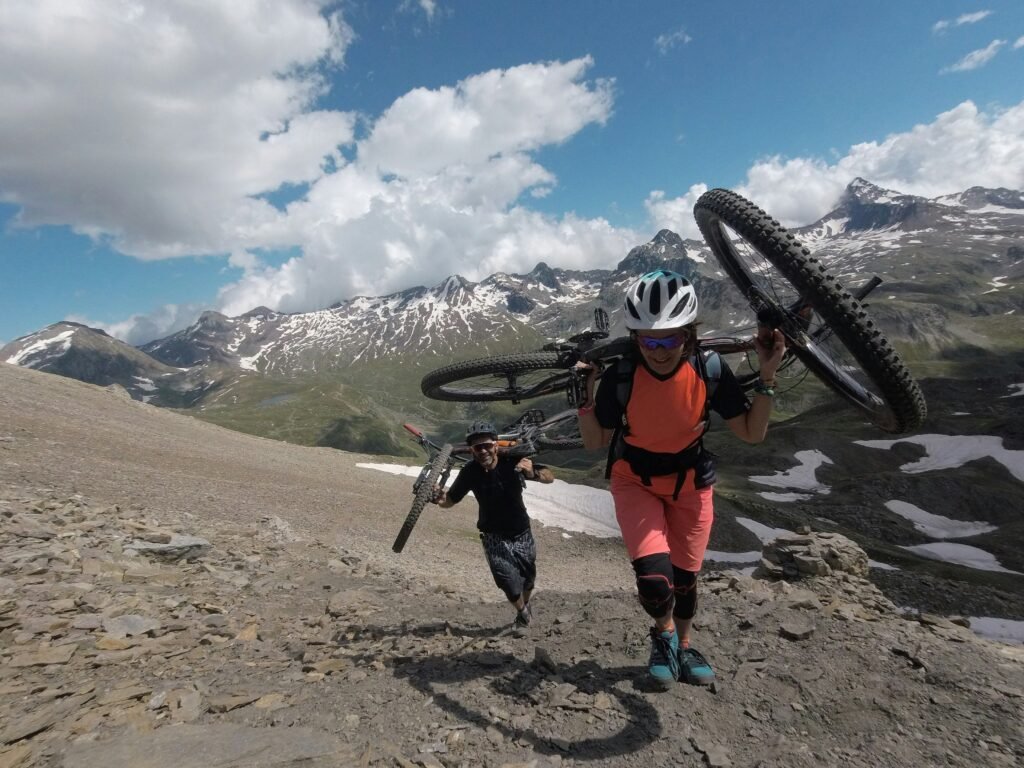
Cycling on unpaved, technical, or trail terrain – from flowy singletrack through forest to sustained technical descents on loose mountain surfaces.
Mountain biking separates into two distinct disciplines within the experience:
Trail Riding (cross-country; self-propelled ascent and descent; sustained effort over terrain) and enduro or downhill formats (gravity-assisted; the descent is the primary event; uplift by vehicle or chairlift to the top).
India’s MTB scene has developed significantly – Manali, Shimla, Coorg, the Nilgiris, and Arunachal Pradesh all have established trail networks.
Internationally, the mountain bike destination map spans British Columbia, Queenstown, Finale Ligure, Whistler, and Sedona.
A peer journal covering the full MTB experience is in production. Primary persona: Physical Challenger · Secondary: Thrill Collector → Mountain Biking / MTB – peer journal [coming soon] → ]
Cycling Tours
Long-distance cycling on road or mixed terrain – a distinct experience from MTB in its tempo;
Its physical demand profile, and the kind of relationship it creates with landscape and distance.
A cycling tour moves through a geography at a pace that reveals things that faster travel skips and slower travel misses:
the gradient of a valley, the smell of a town approaching, the specific quality of arriving somewhere under your own effort.
India’s cycling circuit is emerging – Rajasthan’s flat desert roads, the coastal Karnataka and Kerala highways, the Spiti Valley road, and the Northeast circuits are all established.
Internationally, the Trans-Siberian, the Pacific Coast Highway, the EuroVelo networks, and the Tour d’Afrique define the long-distance ambition.
A peer journal covering the full cycling tour experience — day tours through multi-week self-supported expeditions — is in production. Primary persona: Physical Challenger · Secondary: Slow Traveller → Cycling Tours — peer journal [coming soon] → ]
Horse Trekking
Travel through terrain on horseback – a form of adventure travel that predates almost every other in this hub and remains one of the most direct ways to access landscapes that neither walking pace nor vehicle speed reveals in quite the same way.
The relationship between rider and horse is itself a dimension of the experience – the management of an animal with its own responses to terrain, weather, and the rider’s confidence is a specific kind of demand.
India’s horse trekking geography is concentrated in the Himalayan belt – Spiti, Ladakh, Uttarakhand, and the Northeast; where the tradition of pack-horse travel has ancient roots.
Internationally, Mongolia, Kyrgyzstan, Patagonia, and the American West define the landscape.
A peer journal covering the full horse trekking experience – from first-timer half-day rides to multi-week wilderness journeys – is in production. Primary persona: Physical Challenger · Secondary: Meaning Seeker → Horse Trekking – peer journal [coming soon] → ]
Overland Self-Drive
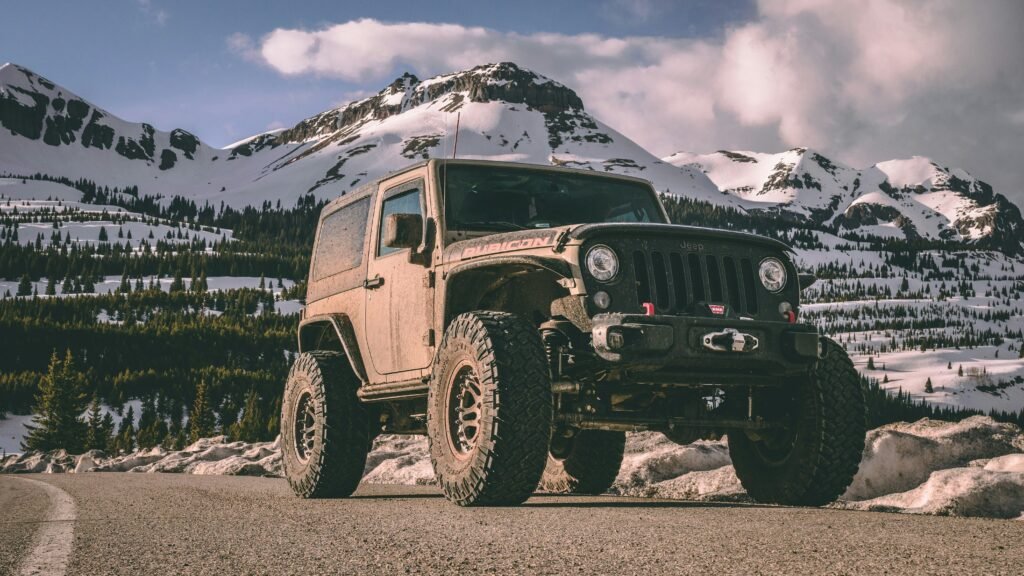
Vehicle-based travel in which the vehicle, its preparation, and the terrain it crosses are as much the subject of the journey as the destination.
GDT’s overland programme covers four vehicle disciplines: motorcycle touring, non-4×4 self-drive, 4×4 self-drive, and caravan self-drive:
each with its own peer journal covering the full depth:
vehicle selection, preparation, gear, recovery, skills, and a complete circuit index rated on the GDT VANCROS Rating (a seven-axis proprietary assessment tool covering Vehicle, Altitude, Navigation, Commodity, Remoteness, Obstacle, and Season).
The Overland Master Guide v3 is the editorial entry point; the VANCROS reference index (v2) and all four vehicle children are built and navigable. Primary persona: Physical Challenger · Secondary: Thrill Collector → Overland Master Guide → ]
Air Adventures
The primary environment: altitude achieved by leaving the ground, either in free fall or in sustained flight - where the experience is defined by what leaving the ground does to the body and the mind.
Paragliding
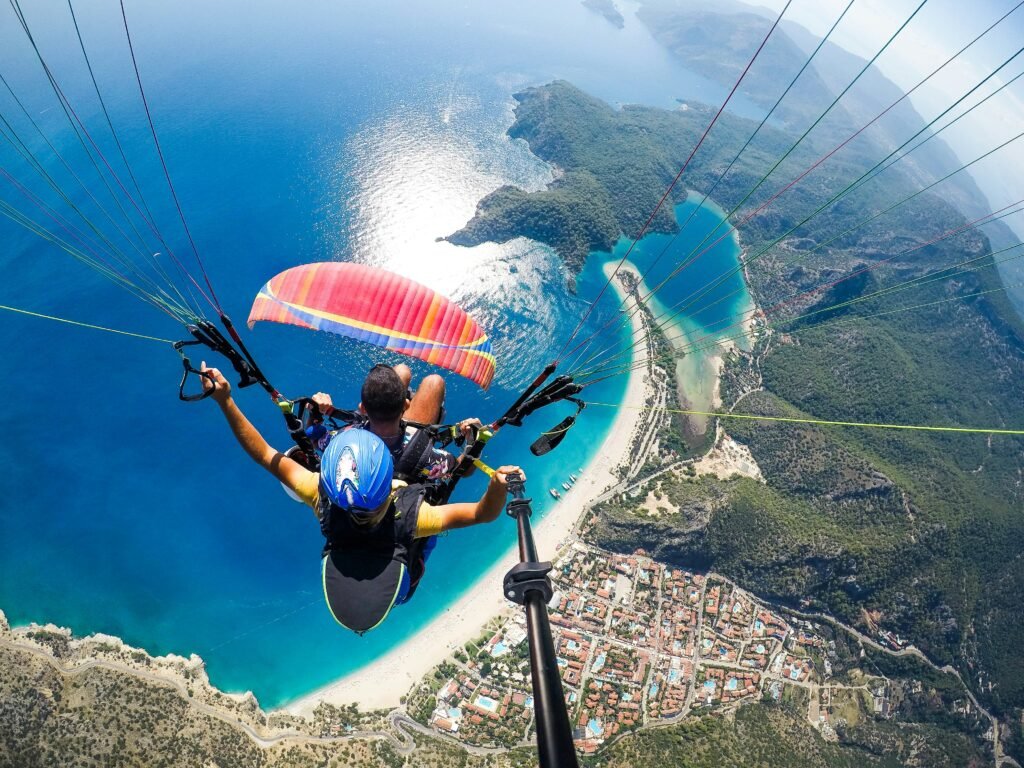
Unpowered flight using a fabric wing and harness, launched from a hillside, sustained by thermals and ridge lift, landed in a designated zone below.
The experience divides into:
Tandem – passenger behind a certified pilot; no prior skill required; accessible on the same day as arrival at a paragliding site); and
Solo – licensed pilot, trained through a certified course; typically 10-15 days of ground and air training for a beginner licence).
Tandem paragliding is one of the most accessible air experiences available – the barrier to entry is genuinely low and the quality of the experience (sustained flight over mountain or valley landscapes; the specific silence of unpowered flight) is high.
India’s paragliding geography is anchored at Bir Billing (Himachal Pradesh);
one of the world’s premier paragliding sites, hosting the Paragliding World Cup;
Kamshet (Maharashtra) and Nandi Hills (Karnataka) are the accessible metropolitan alternatives.
A peer journal covering the full paragliding experience is in production. Primary persona: Thrill Collector · Secondary: Physical Challenger → Paragliding – peer journal [coming soon] → ]
Skydiving
Freefall from an aircraft at altitude, typically between 3,000m and 4,500m – followed by parachute deployment and a canopy ride to the landing zone.
The experience divides into:
Tandem – attached to a licensed instructor; no prior experience required; the entry point for almost all first-timers); and
Solo Progression – through the AFF – Accelerated Freefall, programme;
8 training levels from instructor-assisted to fully independent.
The freefall itself – typically 30 to 60 seconds at speeds approaching 200km/h, produces a sensory state that most participants describe as unlike anything else:
not fear (once the door is open) but a specific quality of presence and time compression.
India’s skydiving infrastructure is limited but growing:
Deesa (Gujarat), Mysuru (Karnataka), and Aamby Valley (Maharashtra) have established drop zones.
Internationally, New Zealand’s Queenstown, Dubai, and Interlaken in Switzerland are the most celebrated locations.
A peer journal covering the full skydiving experience is in production. Primary persona: Thrill Collector · Secondary: Physical Challenger → Skydiving – peer journal [coming soon] → ]
Water Adventures
The primary environment: rivers, ocean, and open water, where the experience is defined by the specific dynamics of moving water, depth, current, and wave.
White-water Rafting
Navigating rivers graded by the International Scale of River Difficulty (Grade I through VI) in an inflatable raft, typically with a guide and a group of paddlers.
The grading scale is the essential planning tool:
| White-water Rafting Grading Scale | Difficulty Level Suitable For |
| Grade I and II | Suitable for first-timers with no prior experience; |
| Grade III and IV | Requires some rafting experience and produce genuine whitewater; |
| Grade V | Expert-only and involves significant risk of capsize; |
| Grade VI | Generally considered non-commercially runnable. |
India’s rafting geography is concentrated in the Himalayan river belt:
The Ganga near Rishikesh (the most accessible; Grade III-IV);
The Teesta in Sikkim, the Zanskar in Ladakh (one of India’s most remote rafting corridors) and the Brahmaputra in Arunachal Pradesh.
A peer journal covering the full white-water rafting experience is in production. Primary persona: Physical Challenger · Secondary: Thrill Collector → White-water Rafting – peer journal [coming soon] → ]
Scuba Diving
Underwater exploration using self-contained breathing apparatus: the SCUBA (Self-Contained Underwater Breathing Apparatus) system that allows a diver to breathe at depth and move freely through an environment inaccessible to surface-bound travel.
The experience divides sharply by certification level:
Discover Scuba Diving session – a supervised introductory experience; no certification required; typically one shallow dive with an instructor, allows an immediate first encounter;
Open Water certification – typically 3-4 days certification; recognised globally allows independent diving to 18m worldwide.
India’s diving geography is concentrated in the Andaman and Nicobar Islands (the most significant; visibility, coral health, and marine life diversity are comparable to the Maldives and Thailand) and in Lakshadweep.
The Maldives, Thailand’s Similan Islands, Indonesia’s Raja Ampat, Egypt’s Red Sea, and Australia’s Great Barrier Reef define the international landscape.
A peer journal covering the full scuba diving experience is in production. Primary persona: Physical Challenger · Secondary: Thrill Collector → Scuba Diving – peer journal [coming soon] → ]
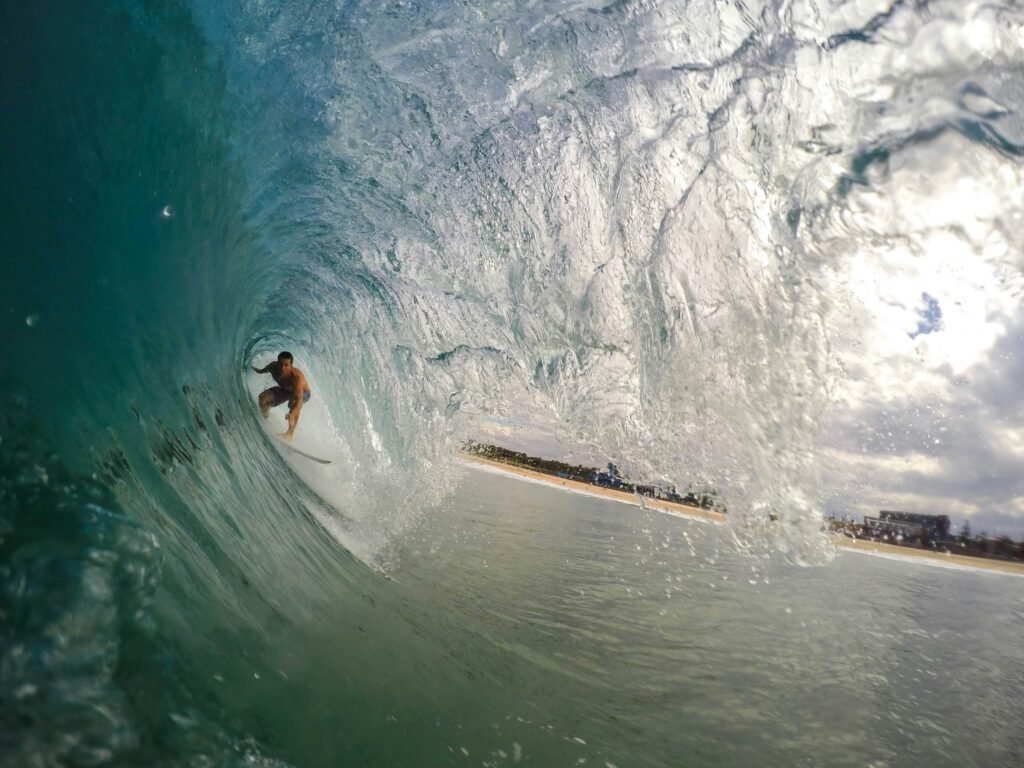
Surfing
Riding breaking ocean waves on a surfboard – an experience that requires reading the ocean, timing the paddle, and managing the specific physical coordination of the pop-up and the ride.
Surfing has the steepest initial learning curve of any water sport and the most specific environmental dependency:
the experience is entirely determined by the quality of the waves, which are determined by swell, wind, and seabed.
The beginner experience – longboard; small, consistent waves; instructor guidance, is accessible within a few sessions.
Competent surfing – the ability to read a break, position correctly, and ride a wave with control, takes months to years of consistent practice.
India’s surf geography is anchored on the Karnataka and Kerala coasts and in the Andamans;
Internationally, Portugal, Indonesia, Sri Lanka, and Australia’s east coast define the learning and development landscape.
A peer journal covering the full surfing experience is in production. Primary persona: Thrill Collector · Secondary: Physical Challenger → Surfing – peer journal [coming soon] → ]
Sailing / Yacht Charter
Travel by sailboat, ranging from a crewed luxury yacht charter (passenger experience; crew manages the vessel —
the guest experience is the water, the ports, and the specific quality of travelling between places at sea level and wind-speed through;
to Bareboat Charter – the charterer is the skipper; sailing competence required; a licence such as the RYA Day Skipper or equivalent is typically the minimum for bareboat; and
Learn-to-sail programmes – residential sailing courses, typically five to seven days, covering the fundamental skills of handling a sailboat independently.
India’s sailing geography is limited but developing – Goa’s coast, the Lakshadweep archipelago, and the Andaman Sea are the primary waters;
Internationally, the Mediterranean (Croatia, Greece, Turkey), the Caribbean, and Southeast Asia (Thailand, Indonesia) define the established charter landscape.
The experience of sailing – the specific combination of skill, weather reading, self-sufficiency, and the quality of arriving somewhere under sail, occupies a unique position between adventure and slow travel that no other experience in this hub replicates.
A peer journal covering the full sailing experience is in production. Primary persona: Thrill Collector · Secondary: Slow Traveller → Sailing / Yacht Charter – peer journal [coming soon] → ]
Snow and Ice Adventures
The primary environment: frozen terrain - glaciers, snowfields, ice walls, and winter mountain landscapes where snow and ice are the defining surface, not merely a seasonal condition of a land environment.
Skiing / Snowboarding
Gravity-assisted descent on snow, on groomed piste, on unprepared off-piste terrain, or in the backcountry beyond the resort boundary.
Skiing and snowboarding share the same mountain environment and the same fundamental physical demand of managing speed and edge control on a descending slope;
they differ in technique, equipment, and the specific movement language the body learns.
India’s ski geography is small but genuine – Gulmarg (Kashmir) is the most significant, with some of the highest lift-served terrain in the world and off-piste that attracts serious international skiers;
Auli (Uttarakhand) and Solang Nullah (Himachal Pradesh) are the other established centres.
Internationally, the Alps, the Rockies, Japan’s Hokkaido, and New Zealand define the global ski landscape.
A peer journal covering the full skiing and snowboarding experience, from first-timer ski school through off-piste and backcountry touring, is in production. Primary persona: Physical Challenger · Secondary: Thrill Collector → Skiing / Snowboarding – peer journal [coming soon] → ]
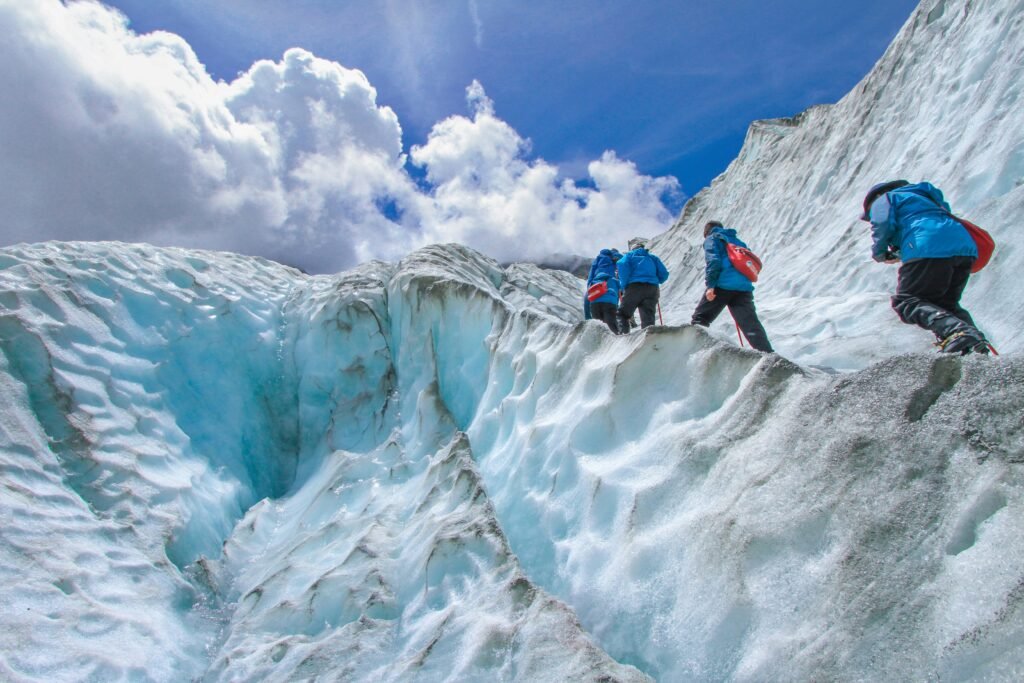
Glacier Trekking
Walking on glacial ice, with crampons, ice axe, and a rope team – as a managed wilderness experience distinct from both standard trekking and technical mountaineering.
Glacier trekking sits at the intersection of the two —
it requires equipment and basic ice craft that standard trekking does not, but stops short of the vertical climbing, crevasse rescue skills, and sustained technical terrain that mountaineering demands.
The experience is defined by the specific character of glacial landscape – the blue-white ice, the crevasse fields, the moraines, the meltwater streams, and the quality of silence that glaciated terrain produces.
India’s glacier trekking geography includes the Gangotri Glacier (Uttarakhand), the Zemu Glacier (Sikkim), and several Ladakh and Spiti glaciers accessible with a qualified guide.
Internationally, New Zealand’s Franz Josef and Fox Glaciers, Iceland’s Vatnajökull, Patagonia’s Perito Moreno, and Alaska’s Matanuska define the global landscape.
A peer journal covering the full glacier trekking experience is in production. Primary persona: Physical Challenger; Secondary: Meaning Seeker → Glacier Trekking – peer journal [coming soon] → ]
Ice Climbing
Ascending frozen waterfalls, ice walls, and glacial ice features using ice axes and crampons —
a technical discipline that sits firmly within the mountaineering skill set but is increasingly accessible as a standalone experience through guided introductory programmes.
The physical demand is intense and specific: the upper body strength required to swing ice axes, the leg strength required to front-point on crampons on vertical ice, and the specific psychological demand of ascending a vertical frozen surface are collectively unlike anything in standard trekking or land-based adventure.
Ice climbing is not a beginner experience – a base level of physical fitness and ideally some prior climbing or mountaineering exposure is required before a first ice climbing session produces more than managed misery.
The introductory format – top-roped; guide-led; short ice walls; indoor ice climbing gyms as preparation, is genuinely accessible; leading on ice is expert territory.
India’s ice climbing opportunities are concentrated in the Himalayan winter season – Spiti, Lahaul, and the Garhwal valleys have established ice climbing zones.
Internationally, Ouray (Colorado), Rjukan (Norway), Cogne (Italy), and Banff (Canada) are the recognised centres.
A peer journal covering the full ice climbing experience is in production. Primary persona: Physical Challenger · Secondary: Thrill Collector → Ice Climbing – peer journal [coming soon] → ]
How to Assess Risk in Adventure Travel
Adventure travel is defined, in part, by risk. Not danger. Those are different things.
Danger is the condition of being in a situation where harm is likely and uncontrolled.
Risk is the condition of being in a situation where harm is possible and managed.
Every experience in this hub involves risk; none should involve unnecessary danger.
The peer journals are honest about the specific risks of each experience —
what can go wrong, under what conditions, and how those risks are mitigated by preparation, operator quality, and the participant’s own decisions.
This honesty is not there to discourage.
It is there because the participant who understands what they are managing makes better decisions in the planning stage, in the operator selection stage, and in the moment on the river, the mountain, or in the air.
Importance of a Safe Adventure Operator
The most important single variable in adventure risk management is operator quality.
The best way to manage risk in an unfamiliar adventure experience is to choose an operator who takes safety seriously – not as a marketing claim but as a demonstrated practice;
visible in their certifications, their equipment, their guide-to-participant ratios, and their willingness to cancel or modify when conditions are not within the safe operating envelope.
Each peer journal covers how to make that assessment.
Frequently Asked Questions
What is adventure travel?
Adventure travel is a form of travel where active participation is central to the experience.
Instead of simply observing a destination, you engage with it physically, technically, or psychologically.
Whether trekking through high mountains, diving beneath the ocean, or paragliding above a valley, adventure travel is defined by what you do, not just where you go.
It combines exploration, challenge, skill development, and personal growth, making it one of the most rewarding ways to experience the world.
How do I choose the right adventure travel experience?
The right adventure depends on three factors: your fitness level, your appetite for challenge, and the kind of experience you want.
Some adventures, such as trekking or cycling tours, are primarily about endurance.
Others, like scuba diving or skiing, require technical skill.
Experiences such as skydiving or surfing often appeal to travellers seeking a stronger thrill component.
The best choice is one that aligns with your current abilities while stretching you in a way that feels exciting rather than overwhelming.
Which adventure activities are best for beginners?
Many adventure experiences are highly accessible to first-timers.
Trekking on beginner-friendly trails, tandem paragliding, introductory scuba diving, Grade I or II white-water rafting, and beginner surfing lessons are all excellent entry points.
These activities require little or no prior experience, are typically guided by professionals, and offer a safe, structured introduction to adventure travel.
What are the most popular adventure experiences in India?
India offers one of the world’s most diverse adventure landscapes.
Trekking in the Himalayas remains the most popular, followed by white-water rafting in Rishikesh, scuba diving in the Andaman Islands, paragliding in Bir Billing, and skiing in Gulmarg.
Other fast-growing experiences include surfing along the Karnataka and Kerala coasts, mountain biking in Himachal and Coorg, and self-drive overland expeditions across Ladakh, Spiti, and Rajasthan.
Is adventure travel safe for first-time travellers?
Yes, adventure travel can be very safe for beginners when approached responsibly.
The key is to choose experiences suited to your skill and fitness level, work with qualified operators, and follow professional guidance.
Reputable adventure operators prioritise safety through trained guides, certified equipment, proper briefings, and weather-based decision-making.
In adventure travel, risk is managed – not ignored.
What is the difference between trekking and mountaineering?
Trekking involves multi-day walking journeys through mountain or wilderness terrain, typically on established routes, without requiring technical climbing skills.
Mountaineering, by contrast, involves ascending peaks that demand specialised equipment and technical expertise, such as crampons, ropes, ice axes, and glacier travel skills.
The difference is not simply altitude; it is the presence of technical terrain that requires formal climbing knowledge.
Which adventure sport is best for thrill seekers?
For pure adrenaline, skydiving is often considered the ultimate thrill experience.
The sensation of freefall is unlike anything else in travel.
Paragliding offers a different kind of thrill – longer, quieter, and more immersive.
Surfing delivers the excitement of reading and riding a moving wave; while advanced white-water rafting combines speed, teamwork, and unpredictability.
The best option depends on whether you seek intensity, flow, or sustained excitement.
How physically fit do you need to be for adventure travel?
Physical fitness requirements vary widely by activity.
Some experiences, such as tandem paragliding or introductory scuba diving, require only basic general fitness.
Others, like trekking (check out Trekking Fitness Score Assessment guide), cycling tours, or skiing, demand moderate endurance and strength.
More advanced pursuits, such as mountaineering, ice climbing, or high-altitude expeditions, require dedicated training and preparation.
A good operator will always help match the experience to your current fitness level.
What should I look for in an adventure tour operator?
Choose an operator with strong safety credentials, experienced guides, and transparent operating standards.
Look for relevant certifications, high-quality equipment, appropriate guide-to-participant ratios, and clear safety protocols.
A trustworthy operator will provide detailed pre-trip information, conduct thorough briefings, and be willing to modify or cancel activities when conditions are unsafe.
In adventure travel, operator quality is the single most important factor in risk management.
Which adventure experiences requires certification to perform?
Certain adventure activities require formal certification if you wish to participate independently.
Scuba diving requires an Open Water certification for unsupervised diving.
Solo skydiving typically requires progression through an Accelerated Freefall programme.
Bareboat sailing charters usually require a recognised sailing qualification, such as an RYA Day Skipper certification.
Mountaineering, backcountry skiing, and advanced climbing disciplines often require formal training, even when certification is not legally mandatory.
For introductory or guided experiences, certification is usually not required.