
Planning an Ayurveda Wellness Experience?

Learn how authentic Ayurveda works, what to expect, how to prepare, what retreat experiences are designed to do, and how to identify genuine therapeutic programmes.
For travellers researching an authentic Ayurveda wellness experience, the biggest challenge is often understanding what Ayurveda retreats are actually designed to do.
While many modern wellness experiences borrow Ayurvedic language, traditional Ayurveda operates through individualized assessment, practitioner-led treatment, therapeutic protocols, prescribed diet, and long-term restoration rather than short-term indulgence.
From Panchakarma detoxification and herbal therapies to consultation systems and retreat structures, authentic Ayurveda retreats function very differently from ordinary wellness holidays.
Understanding those differences is essential before deciding whether this style of wellness journey is aligned with your needs, expectations, and readiness.
Why Ayurveda Retreats Are Often Misunderstood
Ayurveda does not treat your illness. It treats you.
The distinction sounds philosophical.
It is actually the most practically useful thing to understand before you consider an Ayurveda wellness experience, because it determines everything:
What the initial consultation involves;
Why the treatment programme differs from person to person;
Why the diet prescribed for one guest differs from another at the same retreat; and
Why a genuinely therapeutic Ayurveda programme requires more time than most people initially budget for.
Conventional medicine identifies a condition and addresses it with a standardised intervention.
Ayurveda — one of the world’s oldest documented medical systems, with a continuous practice lineage spanning more than three thousand years begins with the person.
The assessment is not of the disease but of the individual constitution:
the specific balance of physiological and psychological qualities that defines this person’s baseline, the ways that balance has shifted under the influence of diet, behaviour, environment, and time, and the specific interventions that will restore that particular person’s particular equilibrium.
This is not holistic language for its own sake.
It is the foundational principle of a medical system, and it has a practical consequence:
Two people arriving at the same Ayurveda retreat for the same general complaint will almost certainly receive different treatment programmes.
The programme is prescribed after assessment, not before arrival.
This journal covers what an Ayurveda wellness experience involves, how to distinguish a genuine therapeutic programme from a retreat that uses Ayurvedic treatments as a spa amenity, what to expect from the experience, and how to find the right programme for what you are actually looking for.
What Authentic Ayurveda Wellness Actually Means
Ayurveda translates from Sanskrit as the science or knowledge of life – Ayur (life, lifespan) and Veda (knowledge, science).
It is codified in ancient texts including the Charaka Samhita (primarily internal medicine) and the Sushruta Samhita (primarily surgery and clinical practice), supplemented by later commentaries that form the working clinical literature of the tradition.
It is not alternative medicine in the sense of being outside mainstream Indian healthcare, it is a parallel medical system with its own clinical training, regulatory framework, and practitioner credentials recognised by the Indian government.
The system operates through a framework of three doshas — physiological and psychological principles that govern different functions of the body and mind:
Vata governs movement, the nervous system, and the flow of breath, thought, and sensation.
When Vata is balanced, the person moves easily through change, thinks clearly, and communicates well.
When elevated through irregular routine, cold, wind, excessive travel, or stress; the qualities of movement become problematic: anxiety, insomnia, dryness, scattered thinking.
Pitta governs metabolism, digestion, and transformation.
When balanced, digestion is strong and motivation is clear.
When elevated through heat, overwork, competitive pressure, or inflammatory diet; the transformative quality turns toward excess: inflammation, irritability, acid reflux, skin conditions.
Kapha governs structure, stability, and immunity.
When balanced, the body is strong and the mind is calm.
When elevated through sedentary lifestyle, cold and damp environment, or excessive consumption; stability becomes obstruction: weight gain, congestion, lethargy, depression.
Every person has a unique constitutional ratio of the three doshas:
Prakriti, assessed in the initial consultation alongside Vikriti, the current state of imbalance.
The distance between the two is the clinical picture the treatment programme addresses.
Therapeutic vs Spa: Why Both Formats Have Value — But Are Not Equivalent
The most important distinction in the Ayurveda retreat market is between a genuine therapeutic programme and a retreat that offers Ayurvedic treatments as a wellness amenity.
Both have value.
They are not the same thing, and the distinction matters enormously for expectation management.
A genuine therapeutic Ayurveda wellness programme begins with a formal consultation:
Nadi Pariksha (pulse diagnosis) alongside a comprehensive health history conducted by a qualified Ayurvedic physician before any treatment is prescribed.
The physician holds a BAMS (Bachelor of Ayurvedic Medicine and Surgery) or MD Ayurveda degree, regulated by the Central Council of Indian Medicine.
The treatment programme is prescribed based on the assessment; it differs between individuals.
The diet is prescribed specifically for that individual’s constitution and current imbalance, not selected from a general wellness menu.
Panchakarma, where prescribed, is administered under medical supervision.
Duration is a minimum of seven days for any meaningful therapeutic outcome; fourteen to twenty-one days for comprehensive Panchakarma.
A retreat offering Ayurvedic treatments provides a menu of treatments:
Abhyanga, Shirodhara, Kizhi, and others, delivered by trained therapists.
These treatments are therapeutic in their own right; this is not a lesser experience.
But it is a qualitatively different one from a physician-directed programme.
Duration can be a fixed stay or a several-day stay; it does not carry the seven-day Panchakarma minimum.
Neither format is fraudulent.
The confusion arises when retreat marketing describes a spa-format experience in clinical language.
Knowing which format you are entering and choosing it deliberately is the most useful preparation for any Ayurveda wellness experience selection.
| Feature | Authentic Ayurveda Retreat | Spa Wellness Retreat |
|---|---|---|
| Physician Consultation | Yes | Often No |
| Treatment Personalisation | High | Limited |
| Panchakarma | Medically Supervised | Usually Simplified |
| Diet | Prescribed Individually | General Wellness Menu |
| Programme Length | 7–21+ Days | Flexible |
| Goal | Therapeutic Outcome | Relaxation & Wellness |
What Authentic Therapeutic Ayurveda Actually Involves
An Ayurveda wellness programme draws from a range of treatments, each prescribed for specific constitutional and therapeutic purposes.
The treating physician selects what is appropriate for each individual; the following is an orientation to the primary treatments you are likely to encounter.
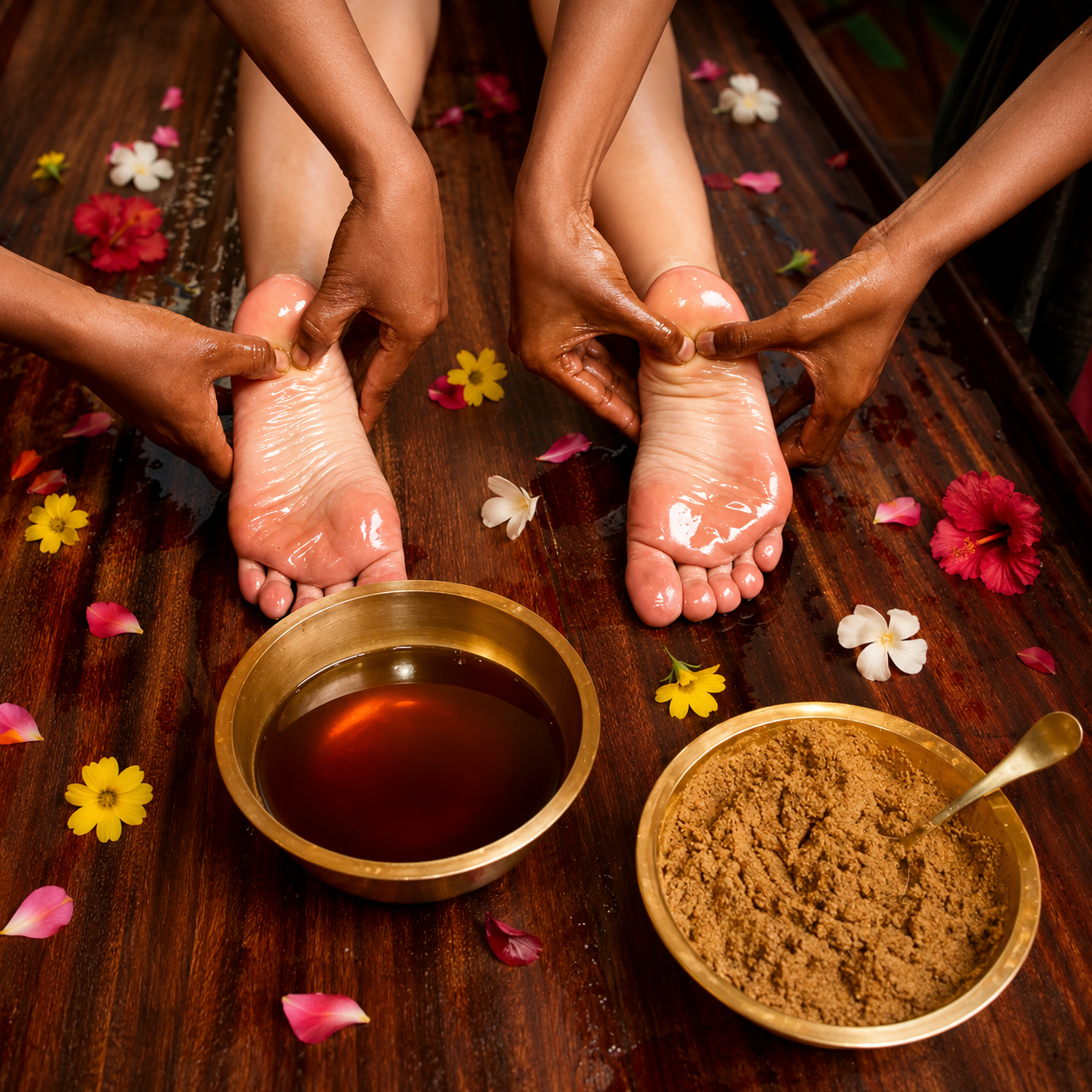
Abhyanga is a synchronised full-body oil massage by two therapists using medicated oil specific to your constitution, the most widely offered Ayurvedic treatment and the foundation of any preparatory Panchakarma phase.
Shirodhara involves a continuous stream of warm medicated oil poured onto the forehead for 30-60 minutes, producing a quality of stillness unlike ordinary relaxation; primarily prescribed for anxiety, insomnia, and stress.
Pizhichil is a continuous warm oil bath over the entire body throughout the session; more total in its effect than Abhyanga; prescribed for Vata and musculoskeletal conditions.
Njavarakizhi uses boluses of Njavara rice cooked in medicated herbal milk applied to the body; deeply nourishing; prescribed for depletion and neurological conditions.
Kizhi is a heated herbal poultice massage with deeply penetrating heat; the primary treatment for joint and musculoskeletal conditions.
Nasya administers medicated oil or herbal preparations through the nasal passage; prescribed for head, neck, and nervous system conditions.
Shiroabhyanga is a focused head and scalp massage; therapeutic for headaches, hair conditions, and general Vata calming.
Udvartana is a dry herbal powder massage; the exception in an oil-based tradition; prescribed for Kapha conditions and stimulation of circulation.
Takradhara mirrors Shirodhara but uses medicated buttermilk; primarily prescribed for Pitta and inflammatory skin conditions.
Panchakarma — the five-action detoxification and rejuvenation protocol that is the most intensive and clinically significant Ayurvedic programme is covered in full depth in the GDT Field Notes Panchakarma journal.
A Day in an Ayurveda Wellness Retreat
The daily rhythm of an Ayurveda wellness retreat experience is significantly quieter and more inward-focused than a yoga retreat.
The treatments are the primary activity; they are not additions to a schedule otherwise full of options.
A day in a genuine therapeutic ayurveda wellness programme typically involves a morning consultation or treatment check-in with the attending physician;
one or two prescribed treatment sessions of varying duration, and meals at prescribed times – typically vegetarian, specifically chosen for the individual’s constitution and current treatment phase.
Lighter and more digestible than ordinary food; no alcohol; limited or no raw or cold food.
Between treatments, the pace is genuinely slow.
Most Ayurveda wellness retreat operators recommend significant rest;
The body is processing the treatments actively, and the rest is part of the therapeutic protocol rather than idle time.
Screen use and vigorous activity are typically discouraged; some programmes explicitly restrict them.
The cumulative effect of this rhythm, unfamiliar for most contemporary people, is a quality of deep slowing that takes two or three days to settle into.
The person who arrives still running at the pace of ordinary life will find the first days uncomfortable; by the fourth or fifth day, most participants describe a quality of physical ease and mental quiet that arrives as a genuine surprise.
Who an Ayurveda Wellness Retreat is For
The Restoration Seeker is the primary persona for the Ayurveda retreat; specifically the person who has reached the stage not just of needing rest but of needing repair.
Where the yoga wellness retreat addresses depletion through practice and the meditation wellness retreat through attention, the Ayurveda wellness retreat addresses it through the body directly;
Through the systematic application of heat, oil, pressure, and medicated substances developed across three thousand years as the most efficient way to restore a system running at deficit.
For the Restoration Seeker whose depletion is physical:
inflamed joints, disordered digestion, poor sleep of long duration, reduced energy;
Ayurveda is the most specifically calibrated response in the wellness experience category.
The Meaning Seeker arrives through a different route, drawn to the encounter with a complete philosophical and medical system that understands the human being differently from the frameworks of contemporary life.
The initial Ayurvedic consultation, conducted by a physician practising within the tradition’s full depth, is one of the more intimate and revealing diagnostic encounters available outside of psychotherapy.
The pulse tells the physician something about the patient’s history and current state that the patient may not have fully articulated to themselves.
Who an Ayurveda Retreat is Not For
a> Someone who needs active engagement rather than receptive rest.
An Ayurveda retreat asks you to receive, to lie on a treatment table, to rest between sessions, to follow a prescribed diet without negotiation.
The person who needs to be doing something will find this genuinely difficult.
b> Someone with undisclosed medical conditions.
Certain treatments, particularly Panchakarma procedures, have contraindications that a qualified physician must assess.
Disclosure before the initial consultation is not optional; it is how the programme is made safe.
c> Someone seeking a rapid fix.
Ayurveda works across time and with continuity.
A week of Panchakarma produces measurable outcomes; those outcomes are most durable when followed by the Paschatkarma protocol and sustained by the dietary and lifestyle adjustments the physician recommends after the programme ends.
Physical Suitability — What to Know and What to Disclose
Ayurvedic treatments are generally gentle in character.
The more intensive Panchakarma procedures involve significant physiological processing that requires a stable health baseline.
Before booking any Ayurveda programme, disclose the following to the programme:
Current medications – particularly immunosuppressants, anticoagulants, and cardiac medications; some Ayurvedic formulations interact with pharmaceutical drugs.
Pregnancy – Panchakarma is contraindicated; many treatments require modification.
Active infection, fever, or acute illness – Panchakarma requires a stable baseline.
Cardiovascular conditions – certain treatments involve heat and require specific assessment.
Specific dietary restrictions or allergies – treatments involve medicated oils and ghee; dairy, sesame, and other ingredients may be relevant.
Mental health history – some treatments, particularly extended Shirodhara and Panchakarma, can produce significant psychological processing as part of their physiological effect.
Disclosure before booking is the mechanism that allows the programme to offer what you actually need rather than what the standard programme delivers.
What Outcomes to Expect — and What Not To
What to Expect
A physical experience genuinely different from anything in the mainstream Western wellness market.
Shirodhara in particular produces a quality of stillness – not sleep, not ordinary relaxation, that most recipients describe as unlike any previous experience.
The cumulative effect of several days of Abhyanga is a physical ease and release that most people associate with how they felt much younger.
Improved digestion and elimination in a Panchakarma programme.
This is the most immediate and reliably documented outcome – a system brought through a structured cleansing process experiences measurable improvements in digestive function and metabolic clarity.
Reduced inflammation and joint discomfort in musculoskeletal Kizhi programmes.
The heat and specific herbal formulations in kizhi treatments have documented anti-inflammatory effects;
participants with chronic joint conditions frequently report significant relief across a programme of five to ten sessions.
The recalibration of pace.
An Ayurveda retreat runs at a speed most contemporary people have not experienced in years. The slowing is itself therapeutic.
What Not to Expect
Immediate results for chronic conditions developed across years.
Ayurveda works with and through the body’s own processes. A fourteen-day Panchakarma produces genuine therapeutic outcomes; those outcomes are not the reversal of years of accumulated imbalance in a fortnight.
Certainty about outcomes before the physician assessment.
Because the programme is prescribed based on individual assessment, it is not possible to know exactly what will be prescribed or what will be experienced before the initial consultation.
A comfortable experience in the conventional sense during Panchakarma.
The preparatory phase and the main procedures produce significant physiological processing that is part of the therapeutic mechanism, not a side effect to be managed around.
How to Evaluate an Ayurveda Wellness Retreat Before Booking
The Ayurveda retreat market ranges from genuine medical institutions within the tradition to facilities using Ayurvedic terminology as marketing for essentially spa experiences.
The Green Flags to Look For
A formal initial consultation with a BAMS or MD Ayurveda physician before any treatment is prescribed.
Physician involvement throughout the programme at regular assessment points.
Prescriptive dietary guidance specific to the individual.
Medicated oils and preparations sourced from verified traditional manufacturers.
Transparency about physician qualifications when asked.
The Red Flags Most Travellers Miss
Packaged Panchakarma programmes with fixed treatment menus and no initial physician consultation.
“Physician consultation” conducted by a wellness consultant rather than a credentialled Ayurvedic doctor.
No stated ingredients or source for medicated preparations.
No enquiry about current medications and medical history before accepting participants.
Qualification Standards
A qualified Ayurvedic physician in India holds a BAMS (Bachelor of Ayurvedic Medicine and Surgery) degree – a five-and-a-half-year integrated programme regulated by the Central Council of Indian Medicine (CCIM) under the Ministry of Ayush.
MD Ayurveda is the postgraduate specialisation. The Ministry of Ayush quality certification framework provides a reference standard for Ayurveda facilities in India.
Five questions to ask before booking:
- Will I have a formal initial consultation with a BAMS or MD Ayurveda physician before any treatment programme is designed?
- Is the physician on-site throughout the programme, and at what frequency will I see them for assessment?
- How are the medicated oils and preparations used in the programme sourced or prepared?
- What is the protocol if a treatment produces an unexpected response during my stay?
- What post-programme guidance (Paschatkarma) is provided, and in what format?
How to Prepare Yourself After You Book
Before the Retreat
Reduce dietary extremes in the two weeks before arrival — less alcohol, less processed food, less cold and raw food, fewer stimulants.
This is not a prerequisite; it is preparation that makes the early days easier and the initial physician assessment more accurate.
Prepare to answer detailed questions about your health history, current symptoms, dietary patterns, sleep quality, and emotional state.
The initial Ayurvedic consultation is comprehensive.
Writing down your health history before you arrive including conditions, medications, surgeries, and significant life events produces a more accurate assessment.
Arrive a day before the programme begins if logistics allow.
The transition from ordinary pace to Ayurveda retreat pace is significant; arriving already inside the retreat environment makes the first consultation and treatment more settled.
What to Pack
Loose, comfortable cotton clothing, oil stains synthetic fabrics permanently.
Old clothing you are comfortable having oiled throughout.
Sandals or flip-flops for easy removal before treatment.
All prescription medications.
Leave alcohol, most Ayurveda programmes prohibit it; Panchakarma programmes prohibit it entirely during the active treatment period.
How to Make the Most of the Experience
Accept the Pace
The slowing is not unproductive time; it is active processing time.
The rest between treatments is part of the therapeutic protocol.
Using this time to maintain ordinary output is working against the programme’s mechanism.
Engage Honestly with the Practitioner
The consultation is not a formality.
The more specific your responses, the more accurately the programme can be designed.
If a treatment produces an unexpected response, tell the physician at the next consultation rather than waiting.
Follow the Dietary Guidance
The prescribed diet is a therapeutic tool, not a catering accommodation.
Choosing food outside the prescribed programme, even food that seems healthy can undermine the treatment’s effect.
Attend the Post-programme Consultation
Before leaving, the physician will provide Paschatkarma guidance, a dietary and lifestyle protocol for the period after the retreat.
This guidance is among the most practically valuable things the retreat offers; the programme’s outcomes are most durable when it is followed.
Top Destinations for Ayurveda Wellness Experiences
Significant Established Destinations
India — Kerala
The uncontested primary geography for classical Ayurveda practice.
Kerala’s combination of high humidity, extraordinary plant biodiversity, and the continuous lineage of classical Ayurvedic knowledge maintained through the Ashtavaidya families makes it the most significant Ayurveda destination in the world.
The monsoon season (June to August) is considered optimal for Panchakarma by classical Ayurvedic texts.
Best dry-season visits: October to March.
India — Karnataka and Tamil Nadu
A strong secondary Ayurveda geography with several well-regarded institutions.
Best season: October to March.
India — Uttarakhand
A smaller but genuine Ayurveda presence, primarily in Uttarakhand’s Rishikesh area.
Best season: October to April.
Sri Lanka
A parallel tradition with specific local character informed by Sri Lankan flora and local practice lineage.
Best season: October to April (west and south coast).
Recently Popular Destinations
Germany and Austria
The most developed European market; a significant Indian and Sri Lankan practitioner community has established clinical Ayurveda institutions across the German-speaking countries.
Best Season: Year-round.
Bali, Indonesia
A growing retreat presence primarily in Ubud. Quality is variable; the tradition is less rooted here than in India or Sri Lanka.
Best season: April to October.
Emerging Destinations
Oman and UAE
A developing Ayurveda retreat presence serving the Gulf Indian diaspora.
Facilities are newer; quality is rising. Best season: Year-round.
Typical Cost Framework
| Tier | What it covers | Approx range per week* |
|---|---|---|
| Basic therapeutic | Shared or basic private room; prescribed vegetarian meals; physician consultation; limited treatment sessions per day | ₹25,000–50,000* |
| Mid-range | Private room; prescribed meals; physician consultation and follow-up; 2 treatment sessions per day | ₹50,000–1,20,000* |
| Premium | Private room with en-suite; high-quality prescribed meals; daily physician consultation; 2–3 treatment sessions; curated environment | ₹1,20,000–2,50,000* |
| Luxury | Private villa or suite; personalised programme; dedicated attending physician; 2–4 treatments per day; exceptional environment | ₹2,50,000+* |
| International premium | European, Bali, or comparable international facility; comparable programme quality; priced in local currency | Significant variation* |
All figures are approximate and highly variable by destination, programme duration, physician availability, and treatment intensity.
What to Do After the Program Ends
The Paschatkarma Protocol
Every serious Ayurveda wellness program concludes with Paschatkarma;
The post-treatment protocol designed to consolidate the programme’s effects and prevent the body from returning immediately to its previous state.
The practitioner prescribes specific dietary guidance, lifestyle recommendations, and sometimes herbal supplements for the period after the retreat.
This guidance is not optional.
The body after Panchakarma is significantly more receptive and more sensitive than before it;
Returning directly to alcohol, heavy food, irregular schedules, and high stress is the most reliable way to negate the programme’s therapeutic work within weeks.
The Timeline of Benefit
Some outcomes are immediate — the quality of sleep after the first Shirodhara;
The reduction in joint stiffness after several days of Kizhi.
Others emerge across the weeks following the retreat.
Others still, particularly the effects on chronic conditions become measurable across months of continued lifestyle adjustment.
The most effective use of an Ayurveda wellness program is as a recalibration that initiates change in the conditions of daily life, not as a one-time intervention.
Continuing the Tradition at Home
The physician’s post-retreat guidance typically includes a Dinacharya;
a daily self-care protocol drawing from the classical Ayurvedic routine:
morning practices (tongue scraping, oil pulling, self-Abhyanga with warm sesame or coconut oil), dietary guidelines specific to constitution, and evening practices supporting sleep.
Beginning with one or two practices and adding gradually is more durable than attempting the full protocol immediately.
Ayurveda does not offer a formula. It offers an assessment — of this person, at this time, in this condition — and a response specific to that assessment. The retreat is an encounter with that specificity.
Frequently Asked Questions
What is an authentic Ayurveda retreat?
An authentic Ayurveda retreat is a physician-led therapeutic wellness programme based on individualized diagnosis, prescribed treatments, dietary protocols, and traditional Ayurvedic principles designed to restore balance and long-term wellbeing.
Are Ayurveda retreats medical or wellness experiences?
Authentic Ayurveda retreats exist somewhere between medicine and wellness. Ayurveda is a recognized traditional medical system in India, but retreat experiences can range from deeply therapeutic clinical programmes to lighter restorative wellness formats.
What is Panchakarma in Ayurveda?
Panchakarma is a structured Ayurvedic detoxification and therapeutic cleansing system involving preparatory treatments, purification procedures, physician supervision, dietary regulation, and recovery phases.
How long should an Ayurveda retreat ideally last?
A short restorative Ayurveda retreat may last 3–5 days, while meaningful therapeutic programmes often require 7–21 days depending on the treatment goals and physician recommendations.
How can I identify an authentic Ayurveda retreat?
Authentic Ayurveda retreats generally include physician consultation, individualized treatment planning, prescribed therapies, dietary guidance, qualified practitioners, and structured therapeutic protocols rather than standardized spa menus.
Are Ayurveda retreats suitable for beginners?
Yes. Many Ayurveda retreats are suitable for first-time participants, though the intensity and therapeutic depth can vary significantly between restorative wellness retreats and clinical Panchakarma programmes.
What should I expect after an Ayurveda retreat?
Outcomes vary depending on the retreat type and individual condition, but participants commonly report improved sleep, reduced stress, better digestion, increased clarity, physical recovery, and greater awareness of lifestyle patterns.
Are luxury Ayurveda retreats less authentic?
Not necessarily. Luxury and authenticity are not opposites. The important distinction is whether the retreat operates through physician-led therapeutic principles or hospitality-led wellness packaging.
Are hospitality based Ayurveda wellness programs still beneficial?
Yes. Treatments such as Abhyanga, Shirodhara, and Kizhi can provide genuine therapeutic benefits even outside a clinical Ayurveda programme. However, they are different from a medically supervised therapeutic retreat.
Which destinations are most respected for authentic Ayurveda retreats?
India remains the world’s most respected Ayurveda destination due to its practitioner lineage, medicinal ecology, climate, and long-standing therapeutic institutions.