
Every petrolhead has a road in their head that they haven't driven yet.
You know the one.
It appeared in a video someone shared, or a photograph that stopped your scroll, or a line in a trip report from someone who did it three years ago and has been talking about it ever since.
A road that crosses something, a pass, a border, a desert; that you have been meaning to drive since you first saw it.
A road that requires something of you before it lets you through.
That road is not a commute. It is not a holiday.
It is not a road trip in the sense that most people mean the phrase.
It is an overland expedition travel and the distinction matters more than most people realise until they are standing at the edge of the Khardung La at 5,359m, watching the valley drop away on both sides, understanding for the first time that the machine under you is the only thing between where you are and where you need to be.
In India, that community is large, loud, deeply opinionated about tyre compounds, and completely serious about the roads they are planning to drive next.
This journal is written for that community.
For the petrolhead who already knows what they want from a road;
They just want to know how to get there better, more prepared, and with enough information to push further than they have before.
Related Overland Journals
Off-Road Overland Expedition: How to Tour Like an Expert
Overland Expedition: Circuits & Routes
4×4 Overland Off-Road Recovery
Check out Other Field Notes Journals: Exploring Adventure, Wellness, Cultural and Wildlife
Why Overland Expedition Travel is Different From Conventional Road Trips
There is a version of travel that uses a vehicle as a taxi; a means of moving between places that are the real point.
And then there is overlanding, where the vehicle is a partner, the road is the experience, and the places along the way are context for what the machine and the terrain are doing together.
The line between a self-drive holiday and an overland expedition is not drawn at a border crossing or a specific road grade.
It is drawn at the moment you start making decisions based on what the vehicle can handle, what the road demands, and how those two things interact over time.
When you choose a route because of its pass altitude. When you pack a second fuel can because the gap between pumps is longer than your tank.
When you turn around not because you are tired but because you have assessed the condition of the next section and decided the risk is not within your margin for this trip.
That is the moment overlanding begins.
India is, by any serious measure, one of the great overland destinations on Earth.
The Himalayan arc alone, from Ladakh and Spiti in the north through the Uttarakhand high ranges to the Northeast Frontier states; offers more terrain variety, altitude challenge, and genuine frontier character than most entire countries.
The Western Ghats offer a completely different register: dense, green, seasonally unpredictable forest tracks with their own specific demands.
The Thar Desert in Rajasthan, the Rann of Kutch in Gujarat, the backcountry of Vidarbha; each zone has its own character, its own seasonal logic, and its own relationship with the machines that cross it.
And beyond India, the aspirational horizon stretches from the Pamir Highway in Central Asia to the outback tracks of Australia, the Mongolian steppe, the southern African 4×4 circuit, and the Pan-American road from Colombia to Tierra del Fuego.
The petrolhead who starts in Spiti and ends in the Gobi is not following a linear path; they are following a logic.
Every circuit completed makes the next one legible.
Every problem solved on a mountain road in Himachal Pradesh is a skill that translates to a corrugated track in Kyrgyzstan.
The machine changes, the terrain changes, but the fundamental discipline of reading a road before it reads you remains constant.
| Conventional Road Trip | Overland Expedition Travel |
|---|---|
| Destination-focused | Journey-focused |
| Infrastructure-dependent | Self-reliant |
| Comfort prioritized | Capability prioritized |
| Fixed itineraries | Adaptive routing |
| Urban connectivity | Remote terrain access |
| Leisure driving | Expedition systems thinking |
Vehicle Choice vs Expedition Capability
Overlanding is not one thing.
It is four distinct disciplines that share a philosophy and diverge completely in execution.
Your vehicle is not just a transport choice, it is a statement about the kind of relationship you want with the road.
The Motorcycle: The Closest Thing to Being on the Road Rather than Above it
There is nothing between a motorcycle rider and the surface they are crossing.
No doors, no cabin air, no windscreen in the traditional sense.
When the temperature drops at 4,500m above sea level, you feel it in your wrists before your instruments register it.
When the road surface changes from graded gravel to loose shale, your body knows before your eyes confirm it.
The motorcycle is the most immersive overland vehicle and the one that demands the most complete union between rider, machine, and terrain.
India’s motorcycle overland culture is anchored in the Royal Enfield.
The Classic, the Bullet, the Thunderbird, and the Himalayan have put more riders into the mountains than any other single manufacturer in the country’s history.
Alongside them, the adventure bike segment. KTM 390 Adventure, Hero XPulse 200T, Royal Enfield Scram 411, BMW G 310 GS, has opened the same roads to a new generation of riders who want the capability of an ADV bike at the price of a commuter upgrade.
Globally, the BMW R 1250 GS, the Triumph Tiger 900, the Honda Africa Twin, and the KTM 1290 Super Adventure define the serious expedition motorcycle tier.
The motorcycle rewards circuits that stop four-wheelers:
The narrow single-track above Chitkul, the switchbacks into Pin Valley, the Zanskar gorge approach roads that are barely wide enough for two wheels.
It also multiplies the consequence of error. There are no crumple zones on a motorcycle.
Preparation – gear, training, mechanical literacy, route intelligence, is not an enhancement at this level. It is a survival variable.
The Non-4×4 — More Capable Than You Think, Right up Until it Isn’t
Most people who drive to Leh from Manali for the first time do it in a car that is not a 4×4.
A Creta, a Brezza, a Nexon. This is not a mistake, it is entirely feasible under the right conditions and with the right preparation.
The non-4×4 self-drive is the most widely practised form of overlanding in India and the most consistently under-planned.
The first time I drove the Manali-Leh Highway I was in a Ford Ecosport with stock tyres, a single spare, and the confidence that comes from not knowing what I didn’t know.
Between Deepak Tal and Pang the road surface changed to something I had not seen before, deep gravel channels cut by a stream that had crossed the road repeatedly over the monsoon season.
The car scraped. Not dramatically. But enough.
I spent the next 45 minutes driving slowly enough that every decision was conscious. I also spent the next three months reading about tyre pressure management at altitude.
The non-4×4 has a real ceiling and a real floor.
Its floor, what a well-prepared standard crossover can handle is higher than most people realise.
Its ceiling, the point at which the vehicle’s ground clearance, traction system, and power-to-weight ratio become the limiting factor, is lower than most people want to admit until they are past it.
Understanding both with precision, for your specific vehicle, is the entire discipline.
The 4×4 — Where Overlanding Becomes a Technical Language
A body-on-frame 4×4 with a low-range transfer case, differential lock, and appropriate ground clearance does not just open more roads, it opens a different category of roads.
Roads that are not on tourist maps.
Roads that require you to get out and walk the next 100 metres before you drive them.
Roads where the correct technique for crossing a river ford is something you have thought about in advance and practised, not improvised under pressure.
I was in a Mahindra Thar in Zanskar, two days from the nearest tarmac in either direction, when the front right wheel dropped into a channel that was not visible under the water surface.
The 4×4 mode had been engaged for the previous four hours.
The diff lock went in. The vehicle came out.
That is the entirety of the story. It is not dramatic in retrospect.
In the moment, it was everything.
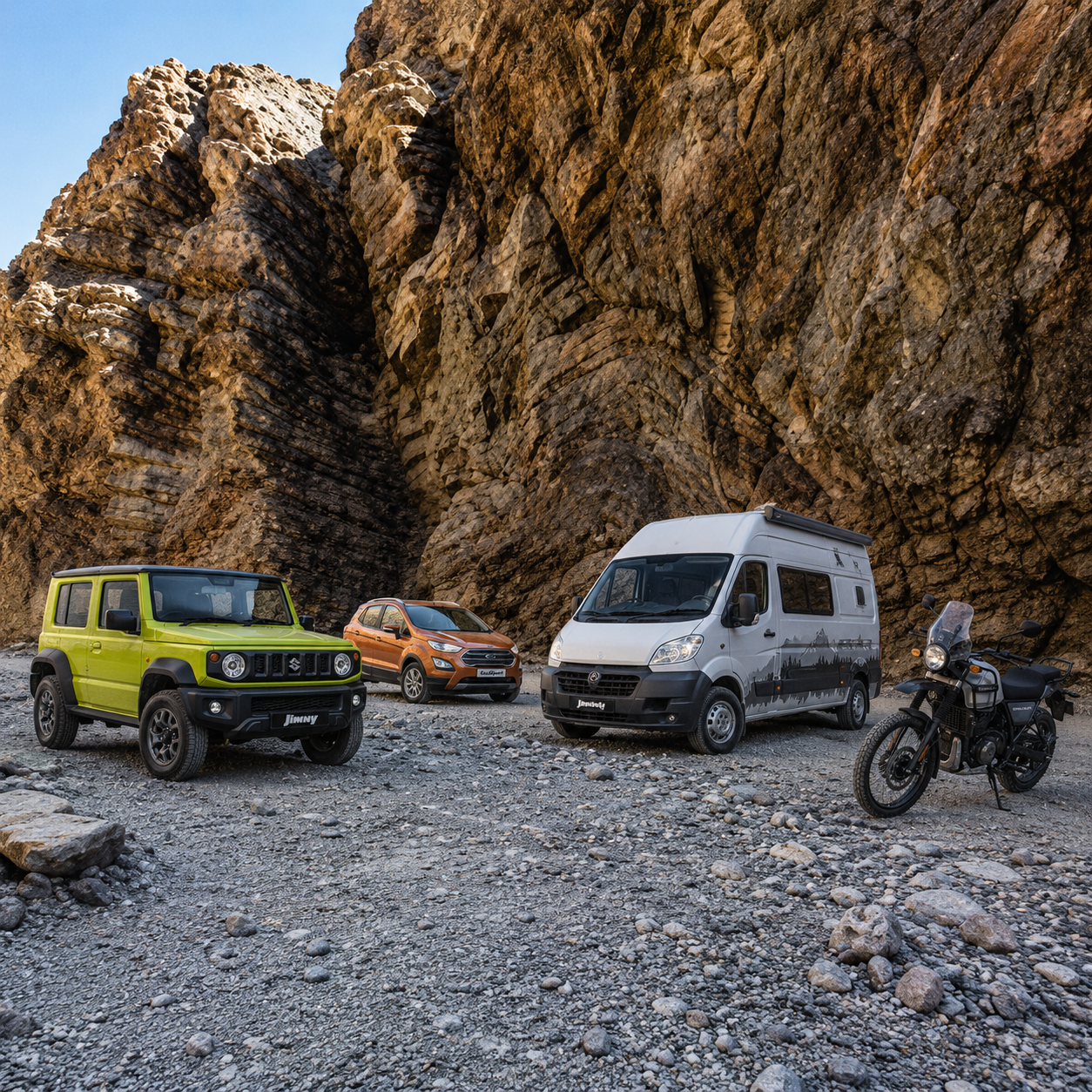
The Indian 4×4 market has matured faster in the last five years than in the previous two decades combined.
The Mahindra Thar and Force Gurkha anchored the accessible end.
The Maruti Jimny brought a new audience.
The Isuzu D-Max and the modified Fortuner pushed the expedition tier upward.
At the serious end – the end where multi-week international circuits on genuinely remote terrain are the target;
modified Land Cruisers, Defenders, and purpose-built expedition vehicles define the capability benchmark.
The conversation in that community — on Team-BHP, in the XBhp forums, in the YouTube channels that document builds and expeditions in parallel; is one of the most technically sophisticated self-education ecosystems in Indian motoring culture.
The Caravan — The Road as Home
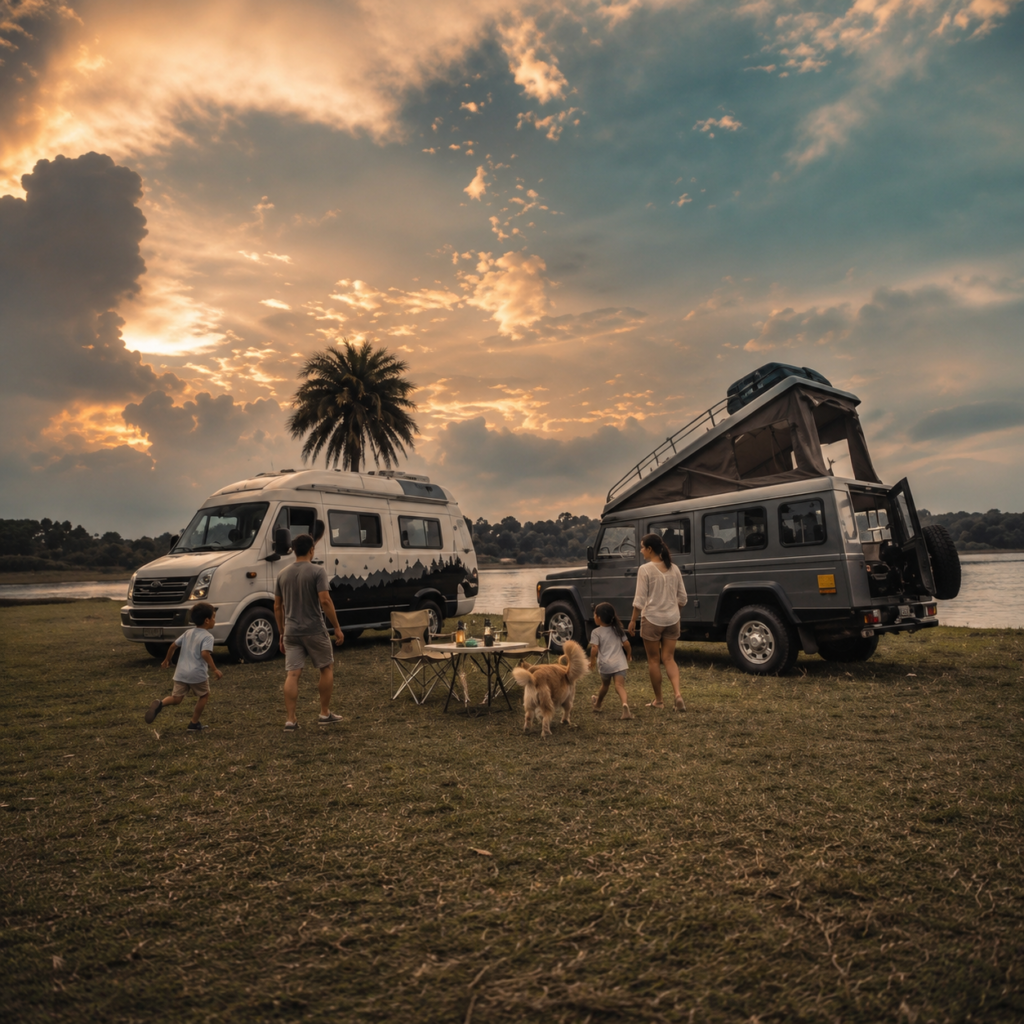
The caravan is the newest entrant to Indian overlanding and the fastest-growing.
It is also, for a specific kind of traveller, families with young children, couples in retirement, people for whom the overnight camp is as important as the drive, the most complete form of the experience.
The caravan is not a compromise.
It is a different relationship with the road:
slower, more deliberate, more attentive to the daily logic of water, power, waste, and the width of the next tunnel.
We crossed into Spiti in a converted Force Traveller that we had built over two years.
My wife drove the first three hours out of Shimla; I drove the Kinnaur section.
By the time we reached Nako, the children had done their homework, we had cooked dinner inside the vehicle, and we were parked above a lake at 3,600m with every window condensing from the cold outside.
That night, the decision to build the caravan instead of booking hotels was obvious to all four of us.
The Indian caravan market has crossed from curiosity to category. Tata Yodha-based conversions, Force Traveller pop-roofs, and purpose-built trailer caravans from manufacturers in Gujarat and Maharashtra have created an accessible entry point.
The towing and driving skills required are genuinely different from solo vehicle overlanding and the planning variables (weight, height, width, campsite access, power management) add a layer of complexity that the community is still collectively learning.
That learning is happening fast, on the roads, and on the communities that document it.
Expedition Formats: How Overlanders Actually Travel
There is no single format for an overland expedition.
The community has developed several distinct models, each with its own logic, its own risk profile, and its own reward structure.
Solo Expedition
The purest and most demanding format.
One vehicle, one rider or driver, complete personal accountability for every decision.
The motorcycle solo expedition is the most visible form;
the image of a single rider on a high-altitude pass is the dominant visual of Indian overland culture.
Solo 4×4 expeditions are less common and carry a specific rescue risk: a solo 4×4 recovery on a remote track without a second vehicle is a different problem from a two-vehicle breakdown.
Solo caravan travel is growing, particularly among retired overlanders who have accumulated the skills to handle it.
Convoy
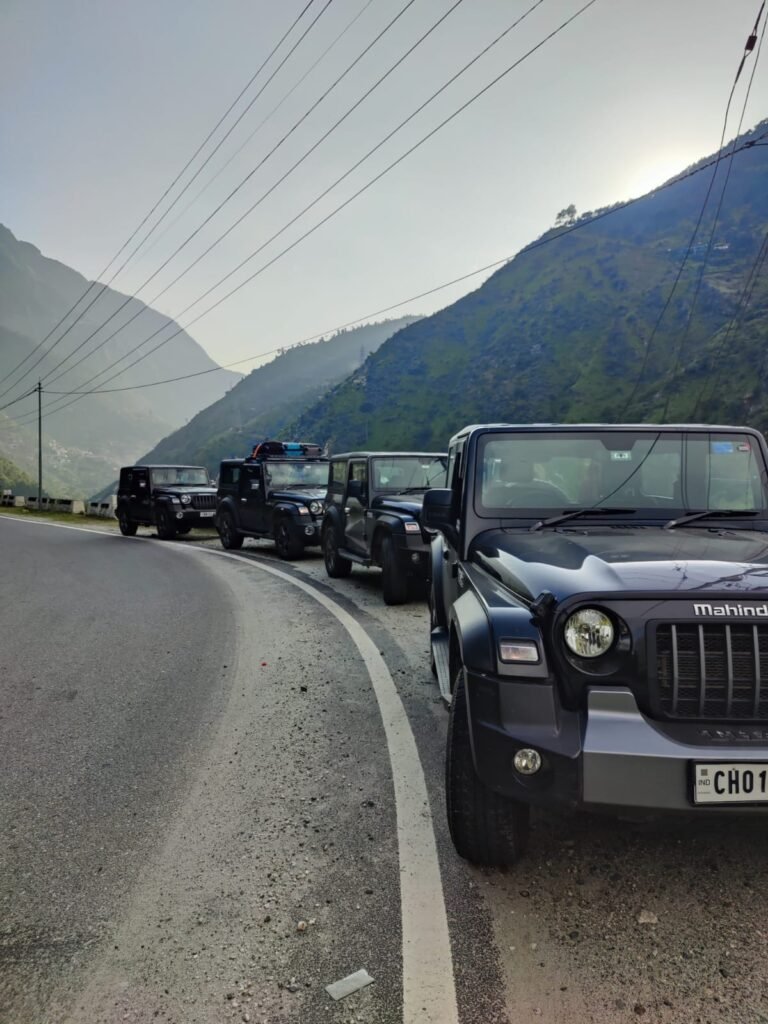
Two to six vehicles moving together as a unit.
The convoy multiplies recovery capability, a stuck 4×4 can be extracted by the vehicle behind it; a flat tyre on a motorcycle is a problem shared.
It also introduces complexity: matching pace across different vehicle types and capability levels, decision-making hierarchy on difficult sections, and the logistical weight of coordinating multiple people’s schedules and fuel needs.
The best convoys are self-organising around the slowest vehicle, not the fastest. The worst ones are not.
Supported Expedition
A format in which a lead vehicle (the overlander’s own machine) is accompanied by a support vehicle carrying spare parts, additional fuel, food, and sometimes a mechanic.
This is the standard format for serious motorcycle expeditions in remote terrain:
A KTM 390 Adventure ridden through the Changthang plateau with a Bolero carrying the camp kit and the rider’s technical support is a fundamentally different enterprise from the same ride unsupported.
Commercially operated supported expeditions where the organisers provide the support structure and the participant brings only their machine and their riding, are growing as a format.
Commercial Group Tour
Organised by a tour host/operator; fixed itinerary; shared logistics; group of riders or drivers assembled by the host/operator.
The quality range is enormous, from operations that provide genuine mechanical support, experienced route leaders, and emergency infrastructure, to operators who hand a GPS track to a group of strangers and call it a guided tour.
Doing due diligence on a commercial operator before committing to a multi-week expedition is as important as preparing the vehicle.
Trending Overland Circuits
The Himalayan Lap
A circuit that connects the three major Himalayan highways, Srinagar-Leh, Manali-Leh, and the Kinnaur-Spiti road, into a single loop.
Typically two to three weeks.
The format has evolved from the early Manali-Leh-back-to-Manali circuit to a more sophisticated loop that enters from one side, crosses through, and exits via a different corridor.
Community consensus on the best entry-exit combination shifts annually based on road conditions and the previous year’s monsoon damage.
The Northeast Frontier Run
Seven states, one loop, typically three to four weeks.
Starting from Guwahati or Shillong and covering Meghalaya, Assam, Arunachal Pradesh, Nagaland, Manipur, Mizoram, and Tripura.
The permit requirements (Inner Line Permit for Arunachal; Protected Area Permit for some zones in Nagaland and Manipur), the road quality variation across the states, and the cultural density of the route have made this one of the fastest-growing overland circuits in India.
The motorcycling community has been doing this for a decade; the 4×4 community has followed in the last three years.
The Bharat Parikrama
A complete circumnavigation of India, typically 18,000 to 22,000km depending on route; 45 to 90 days.
The format started in the motorcycle community and has been adopted by 4×4 overlanders and, increasingly, by caravans.
It is not primarily an adventure route, most of it is on national highways, but the commitment of circumnavigating the country in a single continuous journey has its own specific pull.
Several hundred people complete a Bharat Parikrama each year on motorcycles.
Fewer than ten caravans have done it.
The Pamir Crossing from India
An overland extension that takes the Manali-Leh circuit north through the Karakoram into Central Asia, then west along the Pamir Highway through Tajikistan and Kyrgyzstan.
Requires a Pakistan transit visa or the Khunjerab approach from Chinese Xinjiang, both with significant documentation lead time.
A small but growing number of Indian overlanders are doing this annually.
It is the circuit that converts a Himalayan rider into a serious expedition overlander.
A Carnet De Passages en Douane and International Driving License (IDP) is required to drive your own vehicle to travel cross-country (country specific permit for Africas, Middle East, South East Asia and Oceania; detailed peer journal coming soon on specific routes for cross-country expedition.
Overlanding with a Purpose
A format that attaches a conservation, community, or research objective to the expedition;
Survey routes for wildlife corridors, delivery runs to remote schools, climate documentation in high-altitude zones.
The most rigorous version of this format is indistinguishable from fieldwork.
The growing version is expedition travel that carries a light conservation agenda alongside the core driving experience.